Presenting “Pipazos y jaranas”, an event cycle that revisits the folklore of different contexts and traditions from a queer perspective
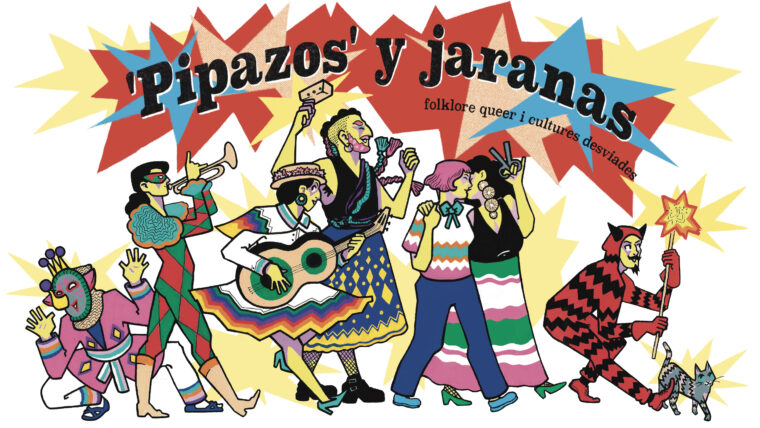
The Barcelona LGTBI Centre presents “Pipazos y jaranas. Folklore queer i cultures desviades”, an event cycle that proposes revisiting folklore and popular culture from different contexts and traditions from a queer perspective.
The programme of activities will be organised between November 2025 and January 2026, consisting of a cycle that borders the playful and the grotesque, recovering the community spirit of the popular festival to meet and celebrate, without ever losing sight of memory, criticism and reflection.
This event cycle starts from an initial question: what is the folklore of the city of Barcelona? Cultural expressions such as demons, fire runs, giants or sardanas? Or cuplé, flamenco and rumba? What role do the migrant communities that have been part of the city’s cultural fabric for years and decades play?
When viewed from this perspective, more questions than answers arise. Who decides what folklore is? What perspective is this decision taken from? Is the idea of folklore a racist, colonial or classist concept or is it a term to be reappropriated? Is folklore understood within what we call “high culture” or is it excluded from it?
Can we say that folklore is intrinsically queer? Can folklore be made queer?
Over the course of these three months, we will aim to reflect on these questions through different activities.
More information in the full activity schedule
Theory and practice, neighbourhood and celebration
“Pipazos y jaranas” will organise different round tables that address the folklore of different communities, from what is considered a culture of Catalan roots, to the popular and deviant culture of “rareta Spain”, without forgetting carnival and the cultural expressions of Andean communities in the diaspora, or the appropriations and oppressions suffered by the Andalusian gypsy community and their artistic manifestations.
To accompany these reflections, the book “Rebeldes del deseo” will also be presented, containing biographies by artists who had to hide their sexual dissidence or risk suffering the consequences of living it freely.
We will also look at other titles that can be consulted and borrowed from the collection at the Casal Lambda Armand de Fluvià Documentation Centre, located in the facilities of the LGTBI Centre.
From a more purely theoretical perspective, we will practice different folkloric cultural expressions to create a sense of neighbourhood and community.
We will organised, for example, a laboratory to research transvestites, copla, variety shows and popular culture, to reconstruct dissident memories from personal recollections, photographs and oral stories.
Another workshop invites participants to give a new twist to the songs and tunes of popular music, such as corrandes or garrotins, to reconstruct a queer songbook that will be brought to life by an ephemeral choir, founded specially for the occasion for just one day.
We will also take advantage of this cycle to reclaim the memory of the peripheries, and offer a guided tour through the history of affective, sexual and gender dissidence in Nou Barris.
And to round off brilliantly, the LGTBI Centre will bring a queer touch to the Festa Major de Sant Antoni, in January, to create a sense of community and be present at the celebration of the neighbourhood that has hosted the facility since 2019.
Colour, irony and protest
The title of the series is a nod to the role of folkloric music in the defence of sexual and gender diversity, referring to a phrase, attributed to Lola Flores, which has become part of popular culture: “¿Quién no se ha dado alguna vez un pipazo con una amiga?”.
The term “jarana”, in turn, evokes the atmosphere of the street party, of revelry, debauchery and coming together around music, dance and other expressions of popular culture.
The design and illustrations of the cycle were created by Quino Coloma da Silva, who has aimed to recreate a diverse and colourful carnival, with a diversity of expressions that are express what we could refer to as queer folklore.