Action Poetry or Poetry of Flesh and Blood: A Remembrance of Carles Hac Mor and Ester Xargay
Julien Blaine and Marc Audí
30.01.2026
CHMEX Exploratory II
Friday 30 January, 7 pm
Espai 4. Free entry, limited places.
Julien Blaine (born Christian Poitevin in Rognac, France, 1942) is a key figure in the European neo-avant-garde, specifically regarding action and experimental poetry. He participated in the May 1968 movement in Paris, where the prevailing subversive and revolutionary social and political sentiment converged with the desire to restore the irreducible energy and integrity of the avant-garde (two ideas that would accompany him throughout his artistic career). In autumn 1968, he created the poetry movement “:” (colon). Since then, he has only continued to promote and organise exhibitions, events and publications of experimental poetry, both in France and abroad. He was the founder of the magazines Robho (1967) and DOC(K)S (1976).
In the late 1960s, he developed a semiotic poetry that was produced through letters and all kinds of signs and can be defined as “post-concrete” and “post-fluxus” (with a demand for a behavioural poetry, in which poetry is experienced at every moment as an integral part of life). Throughout the 1970s, by pushing the internal tensions of fragmentation to the extreme, this work evolved into the concept of poésie élémentaire.
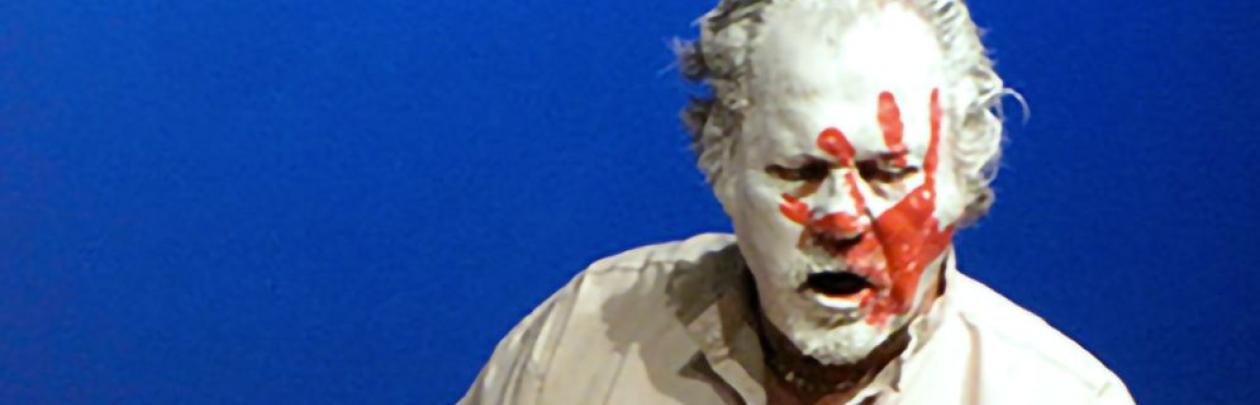
In the late 1990s, the bodily action contained in the poem took on increasing prominence, straddling stagecraft and unbridled irony. It has been said that Blaine’s poetry is a particularly physical experience, more like an action or performance. It is also a process or an uncertain probing. Through the poem turned into action (whose highly prolific publications appear in every imaginable format, from books to posters, records, brochures, mail art, objects, films, magazines, newspapers and so on, and are often considered mere scores, preparatory schemes for action poetry, or which incorporate material and visual poetic aspects), Blaine aims to embody and unshackle language to accomplish and convey what he calls the “bodily quality of the poem”. Or, as Blaine said in a famous 2009 interview with Toni Negri, “To move it, to move it with our whole body, our whole and complete voice”. This is not an alibi. Many of these actions put him in real physical danger, taking him out of his comfort zone, creating a space of uncontrollable violence and always oscillating between the grotesque and the tragic, because “the contemporary poet is ridiculous”.
It is quite symptomatic that Julien Blaine did not limit these actions and his work as an agitator of consciences to the usual spaces of art and poetry. Under the name Jules VAN (an acronym for vrai art nouveau, “true art nouveau”, which he had already been using since 1975 to write a column in the newspaper Libération, of which he had, in fact, been one of the founders and in which he encouraged readers to live more intensely), he sporadically and on multiple occasions practiced the arts of boycott, theft, disguise and sabotage in what, by opposition, we might call “real life” or the “civil world”.
Marc Audí (Barcelona, 1979) is a professor at Bordeaux Montaigne University. His research interests include contemporary Catalan poetry (twentieth and twenty-first centuries), visual poetry, comparative literature and the dialogue between visual art and literature in the early and late avant-garde movements.