

Seen Yet Unseen
Trinh T. Minh-ha
29.10.2025 – 01.03.2026
Curator: Manuel J. Borja-Villel
Opening: Tuesday 28 October at 7 pm
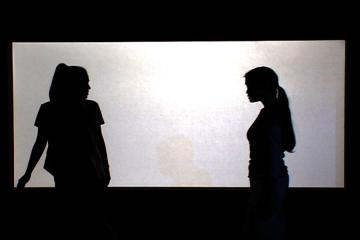
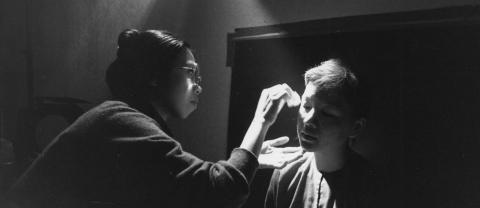
Everything begins with two—Trinh T. Minh-ha (Hanoi, 1952) tells us—although there is no binary opposition in her work, because it is not exclusive, but rather relational. It is open and shaped by a multitude of knowledges and stories. Text and image, sound and silence, testimony and invention fold and unfold without being reduced to one another.
Trinh’s films do not adhere to the conventions of documentaries. The voiceover does not necessarily explain what the images reveal. They sometimes converge with the narration, while at other times they diverge to establish a twofold movement: from the outside in (what is captured from reality) and from the inside out (what could be described as fabulation). Trinh does not seek to convince us of the authenticity of what is shown. Her films do not depict or describe the other. They are not “about” others; they are made with or near by them. This “near by” requires acknowledging both the intimacy and the distance between the filmmaker and those appearing in her films. The author never speaks on their behalf.
Trinh works from a feminist perspective. The presence of women advocating a non-heroic view of our relationships is integral to her practice. Feminism is about raising awareness of those who have been silenced, attempting to give voice to multiplicity.
Feminism is also about emphasising the everyday, a place where time overlaps in layers, where there is no room for the “linguistic self”, that figure of authority associated with Eurocentric reason that demands the universality and veracity of abstract knowledge. There is no linear narrative in Trinh’s films. Her time unfolds in spirals. The past tense may be what is yet to come.
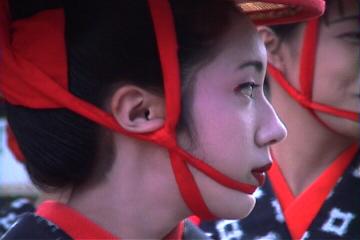
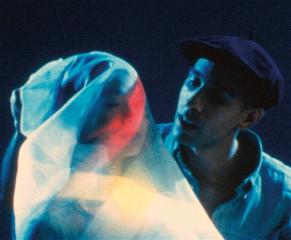
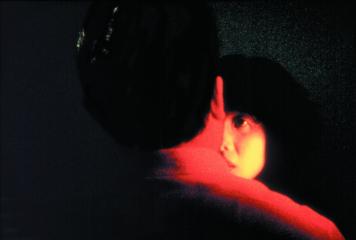
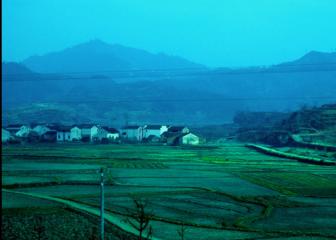
Trinh uses colour very consciously. She plays with its symbolic component. Red is associated with life and joy. It is likewise the colour of antagonism and revolution. White embodies both mourning and purity. There are as many colours as there are gradations in their tones, or uses that have been made of them. Trinh circulates within these nuances, in the interstices that can be found between definitions and things. Her work is situated at a permanent crossroads, forcing viewers to choose.
Trinh T. Minh-ha’s cinema is expanded. It is screened interchangeably in theatres and exhibition spaces. In both cases, the sensory experience is key. Viewers are not overwhelmed by the work as a whole, because the distance between author, screen and viewer is maintained. The medium does not fade away.
Her films are anti-climactic. There is no main story to modulate the narrative, nor a hierarchy to order it. No one meaning prevails over another. According to her, one sees with one’s eyes open as much as with one’s eyes closed. The task of sound likewise does not involve making the image seem more realistic. Silence is as eloquent as sound, and it is governed by its own independent logic. There are no “empty voids” in them; everything is substantive. It is in this paradox that their beauty resides. Seen Yet Unseen is the title chosen by the artist for this exhibition. Another way of looking emerges through this interplay of what is revealed and what remains hidden.
The function of any ideology in power is to show a unified world in a positive manner. Challenging the regimes of representation that govern society means conceiving of a politics capable of altering reality and not merely ideologising it. The conflict this creates leads to a repositioning of subjectivities and practices. Trinh has always been sceptical of so-called “political art” because it ultimately changes nothing. In order to carry out any radical subversion, it is essential to transform the way we perceive the world.