Green transition of businesses
The green transition of businesses is one of the key challenges to ensuring the long-term sustainability of Barcelona’s economic fabric. This process requires companies to adopt more environmentally friendly practices, lower their carbon emissions, optimise natural resources and integrate circularity into their production models.
In a global context where environmental sustainability is a crucial factor for competitiveness, the ability of businesses to adapt to this new reality is essential for their long-term success and the city’s overall well-being.
To tackle the challenge of the green transition, Barcelona aims to implement actions that significantly contribute to this process. These measures address cross-cutting issues such as digitalisation, innovation and sustainability by either directly or indirectly fostering the development of a green economy.
Below are some of the initiatives that will help to drive a greener and more sustainable economic model for the city.
-
Two new economic activity hubs are being set up: the Circular Hub, focused on innovation and the circular economy, in collaboration with Mondragón University and Team Labs Barcelona, and the Urban Tech Hub, promoted by IAAC, Barcelona Tech City and COAC, to connect new technologies with urban planning, architecture, mobility and energy. These two hubs are intended to be innovation spaces that offer business solutions that support the green transition of the business sector across various industries.
-
The Barcelona Commitment to Sustainable Tourism, promoted by Barcelona City Council, the Chamber of Commerce, the Provincial Council and the Barcelona Tourism Consortium, aims to spread a culture of sustainable tourism among the city's tourism service businesses. This commitment recognises sustainable management best practices and requires compliance with criteria aligned with the 17 Sustainable Development Goals (SDGs) of the UN’s 2030 Agenda.
Businesses that meet these criteria can earn the Biosphere certificate issued by the Responsible Tourism Institute. Barcelona City Council fully subsidises the certification process for local businesses. In 2023, responsible management was recognised in 487 tourism operators in the city and 555 in the wider Barcelona region, bringing the total number of certified entities in Destination Barcelona to 1,043.
-
Sustainability initiatives in Mercabarna are improving energy efficiency and lowering emissions through projects that optimise cold storage and use photovoltaic panels. Additionally, efforts are being made to reduce food waste and encourage the use of sustainable products.
The Green Commerce Programme and the Barcelona 2030 Healthy and Sustainable Food Strategy (EASSB 2030) promote a sustainable food model, support the consumption of organic and locally sourced products and contribute to a greener economy.
Sustainability is also being encouraged in Barcelona’s restaurant sector through the ‘Pioners’ training courses and the creation of a network of establishments committed to sustainable practices.
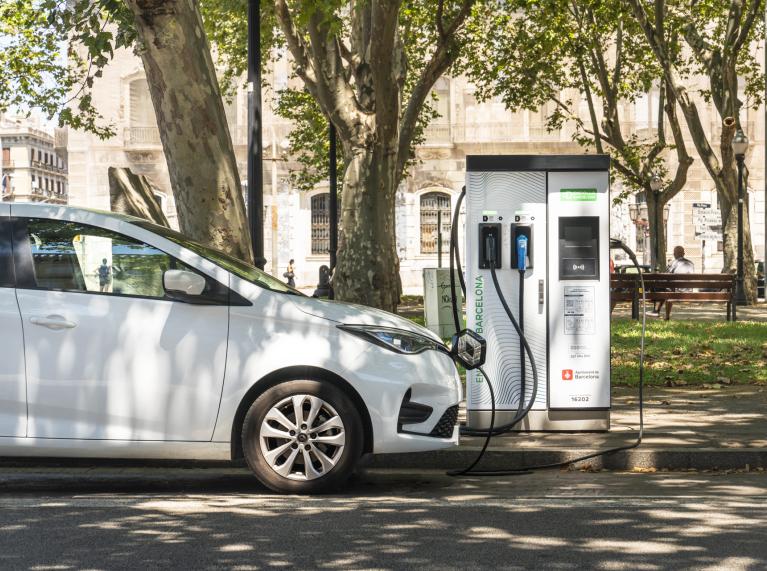
In addition, Barcelona is reinforcing its commitment to electric vehicles. Thanks to SEAT, the city and its surrounding region are transforming automotive production lines to manufacture electric vehicles. This transition is set to continue, with Barcelona City Council supporting the sector to ensure that investments materialise and electric vehicles are widely adopted.