Chronicle "Heritage and living religions: the communities of Barcelona at the Barcelona Museum of Ethnology and World Cultures" #nitreligions2025
On 20 September, the MUEC (Museum of Ethnology and World Cultures) presented a second edition of the activity “Heritage and living religions: the communities of Barcelona at the Barcelona Museum of Ethnology and World Cultures”, co-organised by the OAR (Religious Affairs Office) and the MUEC. It consisted of four guided visits on Hinduism, Buddhism, the Fang worldview, and the Yoruba tradition, under the guidance of people belonging to or linked to these religious traditions.
The activity was part of the programme for the tenth edition of the Night of Religions. Convictions and beliefs in dialogue, organised by the UNESCO Association for Interreligious Dialogue (AUDIR).
Museums act as bridges between history and everyday life, facilitating dialogue with citizens. Exhibitions historically reflect cultural imaginaries and colonial dynamics that have conditioned the way diversity is shown. In this context, Barcelona’s religious and cultural pluralism is presented not only as a historical legacy, but also as a living reality that shapes the city and enriches coexistence.
The guided visits allowed us to experience this dialogue directly, with members of various religious communities or people closely linked to them, who shared their perspective on the heritage objects: what they represent for their community, the associated beliefs and practices, and the history and context they consider relevant to understanding each piece. Thus, the objects cease to be just exhibited elements and become testimonies of memory, identity, culture and spirituality. This interaction offered those attending the opportunity to deepen their understanding of the traditions and rituals that continue to be part of the city’s religious fabric today.
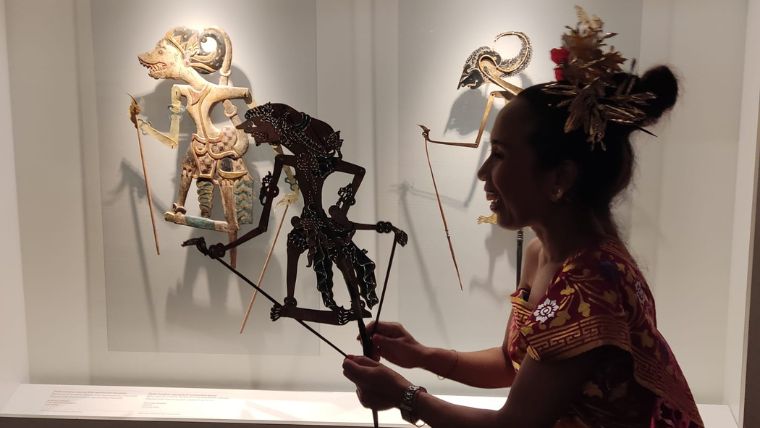
This year, the visit to the MUEC (Museum of Ethnology and World Cultures) began with the Asia collection, with a welcome ritual. Nyoman Hardian Dewi, originally from Bali, follower of Hinduism and leading cultural and religious figure from the Gamelan Barasvara group of the Barcelona Museum of Music, made an offering as a sign of gratitude to the gods and respect for the spirits that inhabit the museum’s spaces. Flowers, incense and rice accompanied the Tari Pendet dance, a traditional welcome dance that was originally performed inside temples and is now also used in cultural events.
Following this offering, the audience had the chance to discover up-close the world of wayang kulit, one of the great treasures of the performing arts of Java and Bali. They were presented with the Hanuman puppets (Java, Indonesia, late 19th to early 20th century) and Arjuna (Java, Indonesia, 19th century). Nyoman explained that these puppets, made of leather or wood and linked to the Hindu epics of the Mahabharata and the Ramayana, represent heroes such as Arjuna —a brave and chivalrous warrior— and Hanuman, the monkey king, a symbol of loyalty and goodness.
During the presentation they were also able to see differences between two types of puppets. On the one hand, the wayang kulit, made of cow or buffalo hide, is finer and designed to play with shadows. On the other hand, the wayang klitik, made of wood and with brighter colours, produces a characteristic sound (“clitic, clitic”) when manipulated and gives a more vibrant tone to the performances.
These pieces helped to show the cultural diversity of Indonesia, a country with more than 17,000 islands and immense artistic wealth. Nyoman Hardian highlighted the differences between the traditions: while in Java wayang kulit performances are usually held at night and are accompanied by gamelan (a musical ensemble of traditional instruments), singing and prayer, in Bali they are part of religious ceremonies and the puppeteer, often a priest, performs with gender instruments and during the day.
The visit enabled us to understand that, beyond their aesthetic value, these pieces have a deep spiritual meaning. In Bali, where the majority of the population is Hindu, it is believed that objects retain spirits, which is why the initial offering was an essential step to open the door to the activity and ensure that everything flowed in harmony.
Next, Ani Chöpal, meditation teacher at the Samye Dzong Barcelona Centre and Buddhist nun, showed two pieces from the Asia collection. Ani Chöpal chose two figures to explain their significance: Buddha Sakyamuni and Chenrezig, the Buddha of compassion.
In relation to the sculpture of Buddha Sakyamuni (Tibet, 1400-1600), Chöpal told the story of the life of Siddharta Gautama, Buddha, recalling how the young prince left the palace after seeing illness, old age and death for the first time. These experiences led him to understand that no one was exempt and that everyone was part of samsara, the cycle of constant suffering in which beings are trapped: birth, illness, ageing and death. After years of asceticism and meditation, he sat under the Bodhi tree and, after overcoming temptations and fears (“maras”), he achieved enlightenment and became the Buddha: “the awakened one, he who sees things as they really are.” This realisation showed that there is a path to nirvana, liberation from the circle of samsara, and that this path involves recognising and transforming the ego and emotions that bind us. As Ani Chöpal said: “First you have to look at yourself, see your negative emotions, and only then can you begin to free yourself from them”.
The second piece she presented was the sculpture of Bodhisattva Sadaksari Lokésvara (Tibet, 14th to 15th century), an image of the four-armed Chenrezig, also known as Avalokiteshvara. It symbolises the four “immeasurables”:loving-kindness, compassion, joy, and equanimity. Ani Chöpal emphasized that the practice of Chenrezig is not about asking for external help, but rather about activating one’s own compassion: “It’s not that Chenrezig gives us compassion; we already have it. He helps us awaken it, just like Buddha: our nature is already there, it is just covered by obfuscations”.
The mantra om mani padme hum is key in this practice. Om represents the body of all Buddhas; mani means jewel in Sanskrit; padme is lotus, and hum is the mind of all Buddhas. When we say om mani padme hum we are invoking Chenrezig and all his qualities. The nun warned that it is not simply “repeating a mantra,” but a sacred practice that is reflected in behaviour: “When you do it well, you notice that the love and compassion within you increase”. Ultimately, in the words of Ani Chopal, it represents an invitation to remember that, “potentially, we are already Buddhas”.
After a short break, we moved on to the collection from the continent of Africa and the visit began with a presentation by Deborah Ekoka, cultural manager and Afrocentric mediator, who presented the Fang culture and pieces from the Eyema Byeri statuary heritage (Equatorial Guinea, 19th century). She described how the Fang, the main ethnic group in the territory of Equatorial Guinea, had a strongly patrilineal culture linked to woodworking. Thus, the byeri figures are central to the worldview: they are not objects of worship, but guardians of the memory of the lineage. The word byeri means “bones”. The byeri were placed on top of cylindrical boxes where parts of the skulls of “illustrious Fang people” were preserved. The byeri sculptures were the bridge, an “anchor” between the world of the living and the dead.
Not everyone could see them: only those initiated into the rituals of spirituality had access to them. They were part of purification ceremonies and dances, often accompanied by visionary plants, with the function of solving collective problems and maintaining communication with the ancestors. The byeri were also cared for with palm oil or animal blood, symbols of strength and vitality.
With colonisation, many of these pieces were looted, burned or thrown into rivers. Ekoka posed the question: “If these pieces were for communicating with the ancestors, what happens when we take them from them?” The debate about restitution is central today. Ekoka concluded by emphasising the need to recognise these pieces not only as art but as a living worldview, and to collectively rethink how they should be preserved: “If we say that the pieces can not be returned because there are no spaces to preserve them, then we continue to impose a Eurocentric way of thinking about how these pieces, which belong to African cultures, should be preserved.”
The final intervention was given by Ana Guillamet, born in Santarém (Brazil), of quilombola (*) origin and African heritage, who eight years ago began her priesthood in Umbanda, an Afro-Brazilian religion with deep Yoruba roots. She presented a figure of Osun, goddess of fresh water and rivers (Yoruba, Nigeria, first third of the 20th century) linked to fertility, creation, cooperation and life energy. In the words of Guillamet: “I am very proud to talk about her, because I am her daughter.” She also showed an Ifa ritual tray (Yoruba, Dahomey (present-day Benin), late 19th to early 20th century). The priestess explained that Osun guides divination and spiritual knowledge through cowrie shells, which are placed on trays and allow personal and collective questions to be answered, becoming a tool for transmitting ancestral knowledge.
In her intervention she emphasised syncretism as a form of resistance during slavery and colonial exploitation, especially in Brazil on the coffee plantations, where Candomblé and Umbanda were born. African deities were identified with figures from Catholicism to protect their spiritual practice: for example, Osun is often associated with the Virgin Mary. However, Ana tells us that December 8th is the day of celebration of Osun within Umbanda.
According to Guillamet, the Umbanda religion works on spiritual and emotional healing, promoting “resistance, resilience and fraternity.” Collective rituals allow us to listen, embrace and share pain without attacking or belittling. “We can reach many people who need the vibrational frequency of love, our collective work.” For Guillamet, seeing the figure of Osun in a museum is also a source of pride and inspiration: “The mother of our house was Osun and it is an inspiration to present her.”
(*) Quilombola is an Afro-descendant who is part of the communities established by enslaved people who fled colonial exploitations (quilombos). Historically, these settlements were created as acts of emancipation to escape slavery.