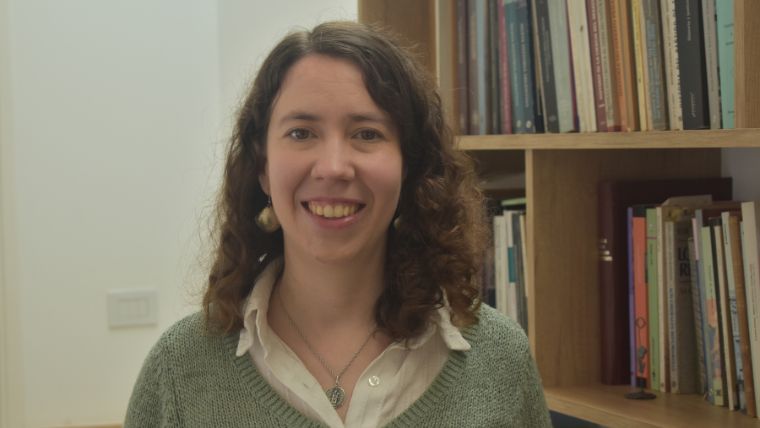
THE INTERVIEW | María Pilar García Bossio: "I believe that Barcelona, and the OAR in particular, has managed to build an institutional continuity that serves as a model”
María Pilar García Bossio has a doctorate in Social Sciences from the University of Buenos Aires (UBA) and is a postdoctoral researcher at the Catholic University of Argentina (UCA) and the National Council for Scientific and Technical Research (CONICET). Since 2022, she has been the advisor for Argentina at the Latin American Association of Social Sciences of Religion. We talk to her about the religious and spiritual plurality of Argentina, the comparison with the Spanish and Catalan cases and the OAR model, as a reference and inspiring model.
Thanks to a grant co-financed by Fundación Carolina and the Catholic University of Argentina, she has been researching at the ISOR team (Research in Sociology of Religion), where she has focussed on the state regulation of religion, how forms of legitimacy, identity, etc. are constructed, a running theme in her previous work in Argentina. Specifically, her research is based not so much on the scale of the great stories of central states, but on a “subnational” scale, that is, on more daily management, exemplified by the offices or religious directorates of Argentina. That is why during her stay she studied the cases of the Fundación Pluralismo y Convivencia (state scale), the General Directorate of Religious Affairs at the Generalitat de Catalunya (autonomous scale) and the Office of Religious Affairs at Barcelona City Council (municipal-local scale).
- How would you describe the current context of religious and spiritual plurality in Argentina? What models are in place for managing this diversity from a public policy perspective?
In Argentina, we tend to distinguish between “religious diversity” and “religious pluralism”. Pluralism is not only recognising that “diversity” exists, but also promoting dialogue as part of this diversity. This distinction has been useful in thinking about public policies on diversity that do not stop at formal recognition, but actively promote its management.
In this regard, Argentina shares some structural points in common with Catalonia, such as a Catholic majority and a sustained growth in non-believers. But the most significant difference with Catalonia is that in Argentina the main minority is made up of other Christian religions, mainly evangelical churches, whose growth has been particularly impressive in recent decades. This represents a challenge in the Argentine panorama, since it questions a “Catholic common sense”, which has been historically predominant, even among non-practising individuals. The visibility of religions of “African origin” has also grown, linked to historical processes such as slavery in colonial times and with a more recent reintroduction of these religious practices from Brazil and Uruguay during the sixties and seventies. Although their communities are small and feature little in the public space, since they are usually discriminated against, they bring new world views that go beyond Judeo-Christian frameworks, and, therefore, introduce new challenges at an institutional and social level. On the other hand, in Europe and Catalonia, the presence of Islam is what tends to generate the main debates and questions about religious common sense. In Argentina, although there are significant Muslim and Jewish communities (especially in Buenos Aires), the strongest challenge to traditional frameworks comes from evangelicals and religions of African origin.
In legal terms, Argentina has a curiosity: there is constitutionally recognized religious freedom, but without formal equality. The National Constitution establishes that the State supports the Roman Catholic Apostolic faith. What does support mean? This is vague and open to interpretation: it can involve economic, symbolic or institutional support. Despite this, the country has legalised public policies that clash with Catholic doctrines – such as equal marriage or legal abortion –, which shows some democratic autonomy. However, there continues to be a legal structure that favours the Catholic Church. For example, it is the only religion for which there is guaranteed spiritual assistance in prisons, hospitals and the armed forces. Other religions can access these spaces, but only through specific dialogue. In some cases, there are experiences such as evangelical pavilions (especially with addiction issues) or synagogues in prisons (Villa Devoto prison in Buenos Aires), but they are exceptional and susceptible to changes in management.
In addition, any religion (except the Catholic Church) that wishes to establish formal ties with the State must register in the National Register of Faiths. This register is held by the Secretary of Foreign Relations of the Nation, and has agreements to initiate the registration process with local authorities. Its operation is based on a decree law issued during the last military dictatorship. Although the regulation is quite generic, in practice, its openness or closure to religious diversity depends very much on the orientation of the official in charge.
Since the return to democracy, there has been a gradual process of openness and respect towards religious diversity, although forms of discrimination still persist. In the formal framework, it has remained the same for decades.
- Could you give us a comparison of religious and spiritual plurality between Argentina and Spain?
During my research in Spain, I interviewed people from three key levels: Fundación Pluralismo y Convivencia (state level), the General Directorate of Religious Affairs at the Generalitat de Catalunya (autonomous level) and the Office of Religious Affairs at the Barcelona City Council (municipal-local level). This framework was familiar to me, since in Argentina there are comparable structures: the National Registry of Faiths at the federal level, the provincial faith directorates and the municipal faith offices.
To provide a framework, in Argentina the geopolitical structure is made up of different levels. First, the National State level; secondly, 23 provinces and the city of Buenos Aires, the country’s capital, which is an autonomous city and has a hybrid position because it has some characteristics of a province (it has its own legislature, its own constitution, etc.) and at the same time is a city (its management has many municipal characteristics), and thirdly, the municipal faith offices.
One point in common is that in both Argentina and Catalonia, even though they have very different histories, there is a very strong “cultural Catholicism”, which comes into conflict with the idea of the secularity of the State or with the more secular separation of the State and, at the same time, with the religious diversity that begins to break this common sense a little. In Argentina, this Catholic preeminence continues within the Constitution, something that in Spain does not.
In Argentina, religions exist in the territory and citizens practice and have religious beliefs, and the State, in some way, must dialogue with them, because it is part of life management. The occupation of public space, the right to access food in accordance with one’s beliefs in certain spaces and to have prayer spaces, or to have their religious festival days recognised, etc., are issues and debates that the State recognises. This does not imply that the State necessarily becomes religious or that it governs for a specific worldview. I believe that this new paradigm is a positive and new challenge. For example, in Argentina, the management of public space is the responsibility of the State. There is a very interesting case of a Catholic pilgrimage, which is the youth pilgrimage of Luján, from the sanctuary of San Cayetano de Liniers (Buenos Aires) to the Basilica of Luján, a route of more than 60 kilometres, crossing different municipalities. In recent decades, organisation between the different municipalities has been coordinated to agree, for example, on whether or not alcohol can be consumed during pilgrimages, since in one municipality it was allowed, in another it was not. Then, the State decided to set out a framework and generated some shared rules. This is an example, but I believe that the State has begun to manage these issues.
Regarding social issues linked to religious areas, in the Argentine case, religion has often been a space for containment, social action, and work with the most vulnerable people in different situations. Thus, the State has entered into a dialogue with these more social spaces and to seek certain regulations. For example, as regards addiction prevention, the State collaborates with religious recovery centres, provided they meet certain requirements. This is in relation to spiritual healing, but for the State to recognise them, they must have what is required of any organisation.
It is also interesting what each level of government can do in terms of religion. Here, the local levels, much of what they can do, whether they have a bigger or smaller budget, has to do with symbolic recognition to a large extent. Because large structures cannot change them, legal frameworks at a country level or at a central State level are completely out of touch with what happens in daily life, but, at the same time, what happens in daily life has an impact. So, for example, the presence of state agents at events organised by certain religious communities is a way of building legitimacy.
The Buenos Aires General Directorate of Faiths has many points in common with the OAR; it was established in 2002 and the OAR in 2005. It is interesting, because they have performed many similar actions without necessarily being in dialogue. In the particular case of the cities of Buenos Aires and Barcelona, it is that both cities present themselves as cosmopolitan and plural, with histories of migration and a conception of diversity as part of the identity of society. In both contexts, religious diversity is linked to cultural diversity, and pluralism is promoted as a value and interreligious dialogue as part of civic coexistence. In both Barcelona and Buenos Aires, I found very similar initiatives. For example, the Barcelona Religions Night began in 2016 with AUDIR, and that same year the Buenos Aires General Directorate of Faiths launched the Night of the Temples. Although they were created separately, they show common concerns and a desire to make religious diversity visible as part of the city’s cultural heritage. Another coincidence.
What I did notice as an important difference in the interviews with the Foundation, the DGAR and the OAR is the degree of professionalisation in public policies on religious diversity, that is, of generating information from the state framework. In Spain, institutions not only interact with academia, but also produce systematic information, and this has a relationship with how management dynamics are thought out. In Argentina, many offices rely on research and people from academia, but do not generate their own information. Furthermore, compared to the DGAR and the OAR in particular, much of this framework is done, in general, with a small budget and limited human resources. Everything depends significantly on the ability of managers to collaborate with other parts of the State.
- More specifically, could you explain to us what faith offices are in Argentine cities? Where are they located and what functions do they perform within the public administration?
At a municipal level, there are offices in the city of Buenos Aires and in the province of Buenos Aires, which is one of the 23 provinces and the one with the greatest concentration of population in the country (they have faith offices in around 36 municipalities out of 135), and there are also offices in provincial capitals. In general, these offices have two central functions: to coordinate with the National Register of Religious Communities, to help religious communities complete registration, verify that they meet legal requirements and facilitate documentation, and to manage religious diversity in daily life. This includes issues such as the use of public space, participation in interreligious events or coordination with areas including but not limited to health, culture or social development. Furthermore, these offices can usually be found in the protocol, cultural or social areas of each government. And they often end up functioning as a one-stop shop: all religious requests arrive here first, and are then referred to the corresponding department.
One issue that has generated debate is who directs these offices. In many cases, especially at the beginning of their development, they were religious individuals (Catholic or Evangelical). When they emerged, they were mostly evangelical pastors, who only responded to their own churches or similar churches. This resulted in partial and exclusive management. However, over time, offices began to professionalise and promote training and academic dialogue. Today, although much remains to be done, there is a greater awareness of the public role that these officials must fulfil, beyond personal faith.
The Buenos Aires General Directorate of Faiths is one of the most consolidated. There are also cases such as that of the municipality of José C. Paz, whose office has existed for more than 30 years. But many others have had irregular cycles: they open and close according to the political will of each mayor, which is indicative of their structural fragility. Currently, there are approximately 50 to 60 religious offices throughout Argentina.
- Do you think that these religious offices in Argentina have been inspired, totally or partially, by the Religious Affairs Office at Barcelona City Council? If so, what elements do you think have been adapted or reinterpreted?
Although not all offices are directly familiar with the OAR, several have been inspired by materials and manuals produced by the Fundación Pluralismo y Convivencia, which in turn collect lessons learned from the Catalan model. In fact, many state agents in Argentina learned about Barcelona’s work through these documents. Recently, a technician from the Buenos Aires General Directorate of Faiths told me that they were researching international models and that they were fascinated by the case of the OAR. This speaks to how these offices are constantly looking for new ideas and good practices, although with much more limited resources.
I believe that Barcelona, and the OAR in particular, has managed to build an institutional continuity that serves as a model. The major challenge in Argentina is to get these offices recognised as important, beyond the political interest of the government in power. In many cases, when management changes, they disappear. Having international models helps to legitimise their existence and permanence. The existence of the OAR is creating a model of what these offices should be and sets out a possible parameter to be achieved.
Personally, I also find the triangulation between academia, civil society and the State that takes place in Catalonia inspiring. In the province of Buenos Aires, a Provincial Council was recently created to manage religious diversity. Now, the challenge is to ensure its continuity and translate these models into policies that are sustained over time.