
The #Trànsits programme continues with the session "Ave Maris Stella", a hymn to the Virgin Mary, protector of seafarers
In February, the programme "Trànsits: les músiques de l'esperit", [Transitions: Music of the Spirit] programme, organised by the Religious Affairs Office (OAR) and the Museu de la Música de Barcelona, as part of L'Auditori’s 2024-2025 “(Contra) Natura” season, will be coming to the Santa Maria del Pi Basilica with the session "Ave Maris Stella".
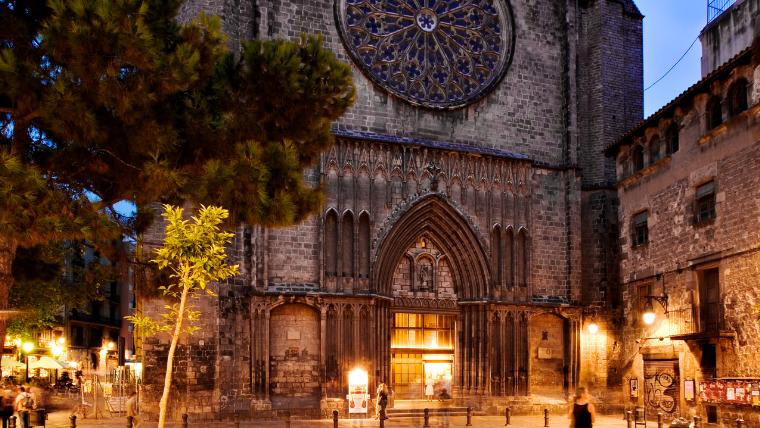
The session will take place on Thursday 20 February and will consist of a liturgy that includes the full Ave Maris Stella mass, by Renaissance composer, Cristóbal de Morales. Beforehand, a conversation will be held featuring experts who will reflect on the importance of music in the Catholic faith.
THE #TRÀNSITS PROGRAMME
The “Trànsits: músiques de l’esperit” [Transitions: Music of the Spirit] programme, organised by the Religious Affairs Office (OAR) and the Museu de la Música de Barcelona, seeks to highlight the link between spirituality and music which characterises the practices of various communities found in Barcelona. Now in its third edition, this year the programme is being organised as part of L’Auditori’s 2024-2025 “(Contra) Natura” season, which charts a journey that explores the relationship between human beings and nature over the course of time. The programme comprises a series of sessions consisting of a preliminary conversation plus a celebration that may be either ritual, liturgical or take the form of a concert, in which music and sound play a prominent role.
AVE MARIS STELLA, WHAT DOES IT REPRESENT AND WHAT DOES IT MEAN?
The hymn Ave Maris Stella, which literally means “Hail, Star of the Sea”, has been a central pillar of the liturgies of the Catholic church over the centuries. Closely linked to the Virgin Mary, it dates back to the 8th century although its predecessors go back even further. Traditionally attributed to Saint Bernard of Clairvaux, this hymn was hugely important during the ‘Middle Ages, a time when the sea symbolised both sustenance and peril. It was in this context that the figure of the Virgin Mary became known as the protector of seafarers.
So the hymn not only reflects this relationship between Catholic spirituality and the everyday life of followers of the faith, it is also testament to the deep-rooted tradition of Marian devotion within Christianity. In Christian theology, the Virgin Mary is seen as a beacon of hope in difficult times, taking on the role of intercessor between humanity and God, as the mother of Jesus Christ. This role makes her a conduit for the prayers and requests of followers and a spiritual guide (a “Star of the Sea”) that lights the way. Invoking the “Ave Maris Stella” thus becomes an act that appreciates and recognises the maternal intercession of Mary.
AVE MARIS STELLA AS A HYMN
Liturgical music seeks to elevate prayer, enrich and strengthen spirituality, and the “Ave Maris Stella” is an archetypal example of this. This hymn, considered a classic in sacred music, has inspired innumerable versions that reflect the evolution of liturgical music over the centuries. Its great adaptability has enabled it to be incorporated into numerous liturgical contexts, from solemn celebrations to moments of personal prayer. This flexibility is one of the reasons why it is still used in contemporary Catholic practice.
So, “Ave Maris Stella” is more than just a hymn. It is a testimony to the profound interconnection between faith and music in the Catholic experience. The ongoing use of this hymn in the Catholic musical repertoire not only underscores the devotion to Mary, it also creates a tangible link between individual spirituality and the community life of the Church.
The piece, which will be sung at the #Trànsits session, is a hymn in Latin, and its name is in fact the opening three words of the hymn: Ave Maris Stella. It is usually sung in The Liturgy of the Hours in the Catholic church on Marian feast days, specifically during Evening Prayer (Vespers).
CRISTÓBAL DE MORALES (1500-1553)
In this #Trànsits session, the mass will feature the piece Ave Maris Stella, by Cristóbal de Morales, with the aim of introducing participants to the relationship between music and religion in the 16th century.
Cristóbal de Morales was a Spanish Catholic priest and choirmaster. He was a leading figure of the Andalusian polyphonic school and was considered to be one of the three great Spanish polyphonic composers of the Renaissance, together with Tomás Luis de Victoria and Francisco Guerrero. His music is eminently vocal and sacred and he is considered to be probably the best Spanish composer of the first half of the 16th century. Cristóbal de Morales made sure his work was published and this helped to ensure it was distributed widely and became hugely popular. His music, which was widely sought after, was printed in cities such as Lyon, Wittenberg, Nuremberg, Augsburg, Anvers, Milan, Rome and Venice. His notoriety and works spread far and wide, not only in Europe but also in the New Word. Many writers and musical theorists, centuries after his death, consider his music to be among the most perfect of the period. The mass Ave Maris Stella is one of his masterpieces.
ENSEMBLE CRISTÓBAL DE MORALES
The Ensemble Cristóbal de Morales, founded in 2023 with the aim of researching and promoting Renaissance music, is dedicated to recovering and disseminating the musical heritage of this historical period. In this session they will be performing Morales’ mass. This session will serve as an introduction – adapted to the Novus Ordo of modern-day masses – to the spiritual and musical context of the 16th century, transporting those attending to the period in which the music was composed – after the Council of Trent-, to form part of the celebration of the Eucharist.
#Trànsits: “AVE MARIS STELLA”
Conversation:
What role did the sung parts of the mass play in the 16th century? What was the impact of the Tridentine reforms on liturgy and on the music associated with it? How can we approach this musical and religious practice today? These and other questions will guide the conversation between Pere Lluís Biosca, director of the Ensemble Cristóbal de Morales, Chiara Mazzoletti, specialist in religious music of the Middle Ages and early modern period, and Sister Conxa Adell Cardellach, Benedictine nun from the Monastery of Sant Pere de les Puel·les and linked to liturgical singing. Moderator: Beza Oliver Martínez.
- Date: 20 February
- Time: 7.00 pm
- Venue: Crypt of the Santa Maria del Pi Basilica (Plaça del Pi, 7). Space with access not adapted for people with reduced mobility.
Free admission until capacity reached.
Liturgy/mass, with accompaniment from the Ensemble Cristóbal de Morales.
It will be taking place at the Santa Maria del Pi Basilica. This historic venue in Barcelona, which holds in its library 16th century editions of Morales’ missals and music, is an ideal setting for this liturgy.
- Date: 20 February
- Time: 9.00 pm
- Venue: Santa Maria del Pi Basilica (Plaça del Pi, 7)
Free admission until capacity reached.