The Mayors for Housing Alliance urges the EU to create a European Affordable Housing Fund to help mobilize €300 billion annually
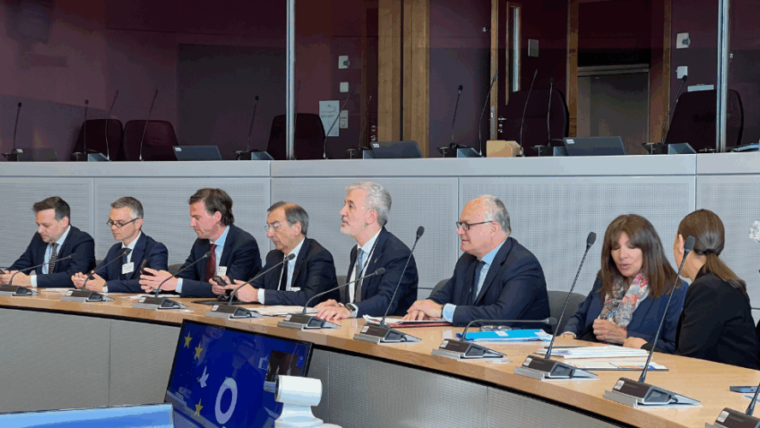
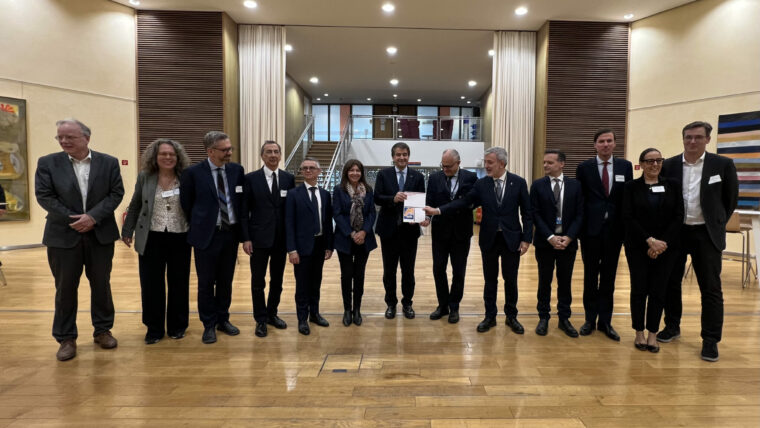
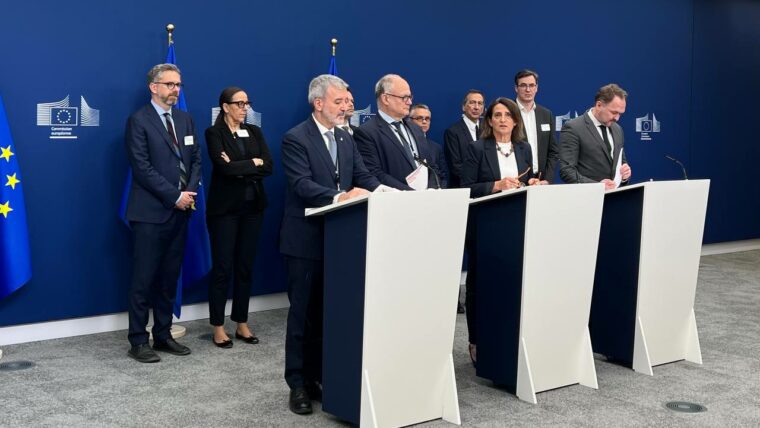
The Mayor of Barcelona, Jaume Collboni, participated in the presentation of the European Housing Action Plan prepared by the Mayors for Housing alliance, which took place at the headquarters of the European Commission on May 15. The document, which aims to influence the first European Affordable Housing Plan that the European Commission plans to present in 2026, gathers the proposals of cities to tackle the housing emergency and the affordability crisis being experienced across Europe.
Also participated in the presentation the Executive Vice-President for a Fair, Green and Competitive Transition of the European Commission, Teresa Ribera; the Commissioner responsible for Energy and Housing, Dan Jorgensen; and the mayors Roberto Gualtieri of Rome, Anne Hidalgo of Paris, Haris Doukas of Athens, Matteo Lepore of Bologna, Gergely Karacsony of Budapest, Sara Funaro of Florence, Giuseppe Sala of Milan, Mathias De Clercq of Ghent, and the Vice-President for Housing and Urban Policy of the Lyon Metropolis, Renaud Payre.
Previously, the group of mayors met with the Executive Vice-President for Cohesion and Reforms, Raffaele Fitto, who is responsible for ensuring the full implementation of the Next Generation funds, working in dialogue with regional and local authorities, and “putting forward an ambitious policy agenda for cities, looking at issues such as housing, climate action, digitalisation, mobility, social inclusion and equality.”
The Mayor of Barcelona -who traveled to Brussels accompanied by the Commissioner for European Affairs, Mar Jiménez– highlighted that “15 major European cities, from different political backgrounds, have managed to agree on a very detailed European Housing Action Plan that we have presented to the European Commission,” adding that “this plan highlights what is now the main source of inequalities between cities in Europe: the housing crisis“.
Jaume Collboni stated “I am convinced that we are on the right path, that we are opening a way that had not previously been opened in European institutions,” and that “for the first time there will be a specific EU program on housing in a transversal way, including energy efficiency, the vulnerability of many groups who have difficulty accessing housing, and it must also cover the needs of the middle class and working families in large cities, who are currently also victims of the housing crisis”.
One of the main proposals of the document is to urge the European Commission to provide a stable and growing flow of funding to cities, which would be established through a new Affordable Housing Fund, following the successful model of the Next Generation funds. This fund should help mobilize at least €300 billion in public and private investment annually for the financing of new social and affordable housing and the renovation of the existing stock in all EU countries.
This initiative should urgently include, in the short term, the reuse of unclaimed resources from the Recovery and Resilience Facility and other released EU funds, which would be allocated directly to local administrations to invest in social and affordable housing and related support services.
To have priority access to these funds, as well as to other European funds, the cities propose the creation of the category of “stressed areas” -to be defined according to various criteria such as the increase in sale or rental prices relative to the CPI or waiting lists for access to social or affordable housing- through a housing market stress index, which would be the main recipients of the new fund.
Housing situation in the 15 cities of the alliance
According to data collected in the 15 cities that are part of Mayors for Housing, in the last 10 years rents have increased on average by 60%, while sale prices have soared by 78%. Based on existing data, it is estimated that to meet the affordable housing needs of the 15 cities, an investment of €80 billion would be required to build 200,000 new affordable homes and to renovate one million more by 2030. This represents a construction target of about one home per 100 inhabitants and the renovation of nearly five homes per 100 inhabitants over the next five years.
The Mayors for Housing alliance expands to a new city
This alliance led by Barcelona, which seeks for cities to play a key role in designing housing policies at the European level and to participate in the management of funds, previously grouped 15 cities representing 17.5 million people, after Florence and Zagreb joined in recent months. On May 15, during the alliance meeting, the incorporation of Dublin was announced, bringing the total to 16 cities. Thus, the cities that are part of the alliance are Barcelona, Amsterdam, Athens, Bologna, Budapest, Florence, Ghent, Leipzig, Lyon Metropolitan Region, Lisbon, Milan, Paris, Rome, Warsaw, Zagreb, and Dublin.
Previous actions of the Mayor of Barcelona in Brussels
On May 14, the European Committee of the Regions approved the opinion “The role of cities and regions in the EU Affordable Housing Plan” promoted by Mayor Jaume Collboni. In addition, this trip to Brussels continues his mission last February, when he participated in the presentation of the “Key Requests” joint declaration of Mayors for Housing, in the Plenary of the Committee of the Regions, and in the hearing on seasonal rentals of the European Parliament’s Internal Market and Consumer Protection Committee. He also met with Commissioner Dan Jorgensen and Vice-President and Commissioner Teresa Ribera, among others.
Subsequently, within the framework of the Cercle d’Economia Conference held in Barcelona on May 5, Mayor Collboni, together with the Mayor of Paris and the Mayor of Rome, met with President Pedro Sánchez to present the alliance’s proposals and obtain his support. On that occasion, Collboni also held meetings with Vice-President Teresa Ribera and with the Executive Vice-President for Social Rights of the European Commission, Roxana Mînzatu.