Logo of Barcelona City Council

Select language

  • Català
  • Castellano
  • English

Other Barcelona City Council websites

The City Council
Contact
Procedures
Work at the City Council
News
Agenda
Map
Getting there
Skip to main content
Barcelona City Council logo
Menu navigation instructions

Instructions for keyboard users

This menu requires arrow keys to be able to use it. The menu has up to three levels:

  • First level: main menu options
  • Second level: sub-options for elements from the first level
  • Third level: sub-options for elements from the second level

Browsing instructions:

  • Browse using the vertical arrow keys on the first level of the menu.
  • Use the right arrow key to display the second level.
  • Browse on the second level using the vertical arrow keys.
  • Use the Escape key to get back to the first level.
  • Use the right arrow key to display the third level.
  • Browse the third level by using the vertical arrow keys.
  • Use the Escape key to get back to the second level.
  • Alternatively, use the Enter key to display any level.

Dones i feminismes

Menu navigation instructions

Instructions for screen readers and keyboard users

This menu requires arrow keys to be able to use it. The menu has up to three levels:

  • First level: main menu options
  • Second level: sub-options for elements from the first level
  • Third level: sub-options for elements from the second level

Browsing instructions:

  • Browse using the horizontal arrow keys on the first level of the menu.
  • Display and browse on the second level using the vertical arrow keys.
  • Use the Escape key to get back to the first level.
  • Use the right arrow key to display the third level.
  • Browse the third level by using the vertical arrow keys.
  • Use the Escape key to get back to the second level.
  • Alternatively, use the Enter key to display any level.
  • Who we are
    Who we are
    • A feminist city
      • A feminist city
      • A feminist city
      • Management of Feminism, Gender Transversality and LGTBI services
      • Barcelona Women’s Council
      • Strategic lines
  • Services and programs
    Services and programs
    • Citizen help and information services
    • Prevention and awareness-raising programmes
    • Promotional actions
  • Gender policies
    Gender policies
    • Gender mainstreaming strategy
    • Scope of application
    • Gender in numbers
    • Feminist methodology booklets
  • BCN free from sexist violence
    BCN free from sexist violence
    • Channels for addressing gender violence
    • Detecting gender violence
  • Days and conferences
    Days and conferences
    • International events
    • 8M International Women's Day
    • 25th International Day for the Elimination of Violence against Women
  • Resources
  • Home
  • Who we are
    Who we are
    • A feminist city
      • A feminist city
      • A feminist city
      • Management of Feminism, Gender Transversality and LGTBI services
      • Barcelona Women’s Council
      • Strategic lines
  • Services and programs
    Services and programs
    • Citizen help and information services
    • Prevention and awareness-raising programmes
    • Promotional actions
  • Gender policies
    Gender policies
    • Gender mainstreaming strategy
    • Scope of application
    • Gender in numbers
    • Feminist methodology booklets
  • BCN free from sexist violence
    BCN free from sexist violence
    • Channels for addressing gender violence
    • Detecting gender violence
  • Days and conferences
    Days and conferences
    • International events
    • 8M International Women's Day
    • 25th International Day for the Elimination of Violence against Women
  • Resources
  1. Home
  2. / Gender policies
  3. / Gender in numbers

Domestic and care work

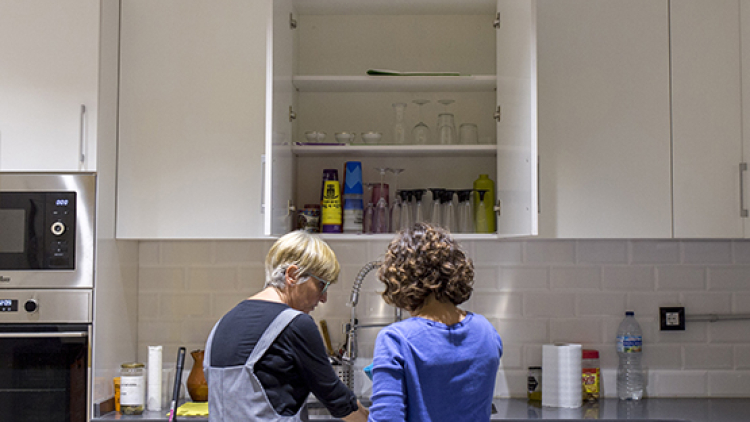
Domestic and care work encompasses those fundamental activities of sustaining, well-being and reproducing life, as well as producing essential elements for its maintenance (meals, clothing, hygiene, etc.). These are everyday tasks, without which life could not exist.

This set of tasks has traditionally been carried out by women, almost alone, and has not been valued socially or economically. Although men are increasingly participating in it, for now they still do so in much lower proportions than women.

Note for screen reader users. This gallery shows one element, which can be an image or a video. Use the controls from the ‘Gallery Controls’ area to show the previous or the next element. You can also click on the element you wish to visualise.
Slide 1 of 1
  • Social perceptions of care work
  • Informal care needs and networks
  • Care as unpaid work
  • Care as paid work

Social perceptions of care work

Caregiving is often invisible and the tasks it involves are relegated to the home, where they can be ignored or undervalued. This lack of recognition makes it difficult to share it, to dignify it as work and to pay attention to the living conditions of the people who carry it out.

Informal care needs and networks

In general, women are more accustomed to talking about the issues that concern them than men. One reason may be related to the fact that even today it is considered “unmasculine” to ask for help. In addition, women interact more in local networks, such as their neighborhood, which makes it easier for them to share their emotions and needs.

Care as unpaid work

In 21st century Barcelona, ​​unpaid care work still falls mostly on women. As it is not shared among household members, nor is it sufficiently attended to by public institutions, it often becomes an overload and causes inequalities.

Care as paid work

Many households outsource cleaning and care work, which is mainly carried out by women, usually migrants, and often in precarious jobs. As a result, in recent decades what are called global care chains have emerged: these migrant women have left their dependent family members in their country of origin, often also in the care of other women, to come here to work caring for other people.

  • Main sections

    • Citizen help and information services
    • Prevention and awareness-raising programmes
    • Promotional actions
    • Channels for addressing gender violence
    • Gender in numbers
  • Contact

    • Inquiries

    • 010 (citizen information)

    • Complaints and suggestions

  • Newsletter

    The latest news, directly to your mailbox!

    Subscribe
Barcelona City Council logo
  • Sitemap