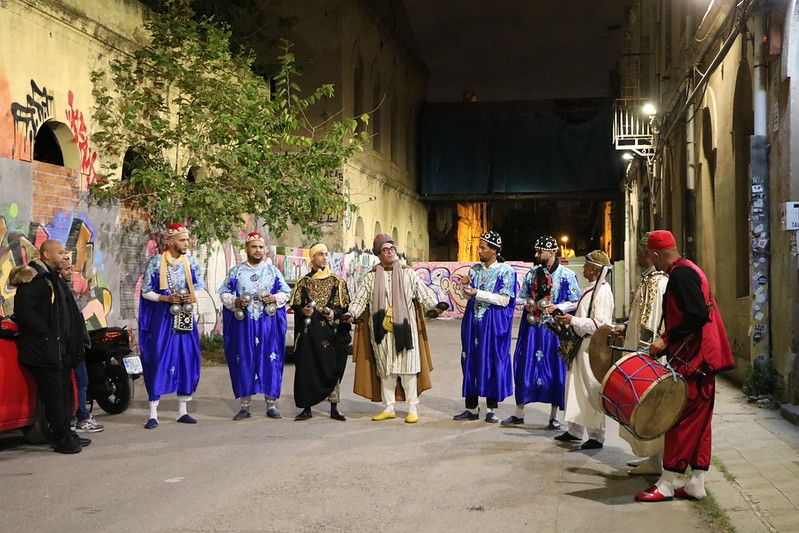
ISLAM | The sound spirituality of the Gnawa community
The Gnawa community originates from sub-Saharan regions, descended from people who were enslaved and relocated over centuries by Arab and Berber rulers to Morocco and throughout the Maghreb. Today this community crosses borders and can be found in European cities such as Paris, Brussels or Barcelona itself, where it has become a bridge between cultures.
The Gnawa are Sufi brotherhoods or turuqs, who practice a mystical Islam in which music and dance play a central role. The music, which combines classical sounds from Islam and other popular pre-Islamic sounds, becomes very rhythmic and has a fundamental vehicular role. This artistic and spiritual expression, recognised in 2019 as an intangible cultural heritage of humanity by UNESCO, combines ritual poetry, traditional music and movement in ceremonies of great spiritual and symbolic intensity.
Their heritage is well preserved and combines ritual poetry with traditional music and dance. Gnawa musical and choral practice is deeply linked to spirituality. A key element of the Gnawa tradition is the Lila or Derdeba ritual, a religious and spiritual celebration that can last one or several nights, for prayer, healing and a communal encounter with the spiritual world. In fact, lila literally translates as ‘night.’
The ritual takes place in seven stages, each of which is associated with a colour and its own repertoire, and is led by a gnawa maalem (master) with vocals and the guembri, a three-stringed bass lute covered in animal skin, considered to be the essential melodic instrument of the group. He is accompanied by the koyo, percussionists and choristers who play the karkabas —metal castanets— and the tbel, a drum that announces the start of the ceremony. The public, often integrated into the celebration, accompany them with clapping and singing.
The Gnawa vocals and songs are performed in responsorial alternation between soloist and choir, evoking and praising holy figures, protective spirits and praises to Allah and the prophet Muhammad. The faithful and attendees participate with clapping, singing and exclamations of devotion (“saha!”) that express gratitude and religious fervour.
If the music is rhythmic, so are the dances. Participants usually move their heads in a circular motion, moving the rest of their body briskly from side to side. Then they spin around, in the manner of dervishes, while bending down and continuing to spin. In this way, they can enter a trance.
Today, Gnawa music represents much more than a cultural manifestation: it is a channel for cultural dialogue and living spirituality and an expression of plurality in a diverse, rich and dynamic Barcelona.