


Research projects
Awakening the dormant sound
Most musical instruments in museums are not in a condition to be played. Restoring them so that they can be used again is not always the best option. It would often be necessary to replace some parts, which could lead to alterations and loss of historical information.
In 2010, we began a research project and possible restoration of the guitars in the collection to find out if we could recover some of them for musical use and make a recording. The project was exciting. In addition to the museum team, we needed the collaboration of specialised restorers and musicians.
In the first selection phase, we assessed the state of conservation, restoration and historical or musical interest. Of the ninety guitars in the Museum, we showed ten to guitarist Xavier Díaz-Latorre, with the aim of finding out whether he considered them interesting enough to play. At the first meeting, I began to give a detailed description of the instruments, but the musician immediately stopped me. He was moved and needed to take in what he was seeing.
Before him were guitars from the 16th to 19th centuries that had not been played for over a hundred years, and he had to choose which ones to restore. Obviously, at that moment, none of the instruments were in musical condition; it was not even possible to tighten their strings to tune them. However, his fingers caressed some of them, and the long silence of those instruments began to break.
Four were chosen, but today I will only talk about one. The Lion's Guitar. It is an instrument built in the Iberian Peninsula around 1700. Its name comes from the rich marquetry inlays, among which two lions stand out. It shows many signs of use, probably from having accompanied singing or dancing.
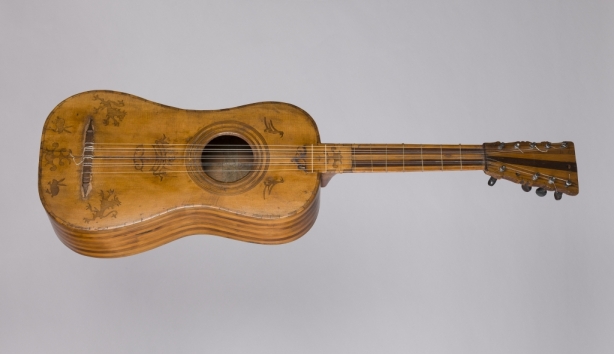
Lion's guitar, MDMB 639 (Photo: Eduard Selva)
The things we know about this instrument may not be enough to explain the whole story. But I'm sure we know a thousand stories, escorts, arrivals, viscudes or desitjades that can show a passat, perhaps imaginat, but not menys cert that a story explains in a winter evening.
I explain it to you.
The tale
It happened at the end of the 17th century, we know that for sure, because wood does not lie and the work done by human hands is written in the object that remains.
That king, rich, noble and lord of his subjects, was sensitive to the art of sound and a lover of beauty. One day he wanted a guitar that combined the highest sound quality with perfect form and rich ornamentation. He wanted to show his power with that instrument.
The finest woods, brought from distant countries, had to be worked with delicacy and ostentation. The object had to dazzle the world and, at the same time, its music had to transport listeners beyond the pleasure of the senses.
And the luthier who received the commission saw before him an almost impossible task. He knew that decorative ostentation did not go well with sound quality. He was the best in the country, knowledgeable about the history of instruments and all the secrets of their construction.
He began by selecting the wood. Although the assignment required the use of exotic woods, he didn't pay much attention to it. The local woods were good enough. He had collected them himself and left them to dry for many years.
He did not hesitate to use cypress and walnut, and for the soundboard there was no better wood than spruce. And if the king wanted exotic woods, he would also use ebony. It was a hard, elegant wood, which he often used to reinforce the neck. The design and construction posed no problem for him. He could build a guitar with five strings, four double and one single. It would be a good instrument to accompany dances. The problem was the decoration. He had seen musical instruments from distant cultures, often highly ornamented, but every detail had a meaning and every instrument had a function. Decorative symbolism is not the same as ostentation.
He also knew of many instruments encrusted with precious stones and excessive decorations. They undoubtedly belonged to important and wealthy people. They may even have been beautiful, but their sound would certainly not have charmed anyone.
How could he avoid detracting from the most important aspect of the guitar: its sound?
By combining walnut and cypress in the sides and back of the instrument, he could achieve a good effect. These were elements of the guitar that did not greatly influence the quality of the sound.
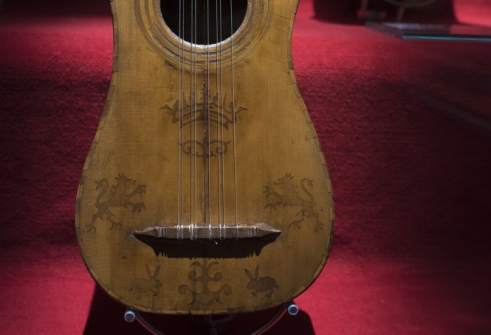
He chose to create very fine marquetry figures, inlaid on the lid, so thin that they would hardly alter the movements of the wood when it vibrated.
The figures he made had symbolic meaning. The crown, because it was for a king and he could not forget that. Two lions, representing nobility and dominion, would be to the monarch's liking. The luthier, however, thought more about the strength and flexibility of these felines: they would surely know how to move with the sounds of the guitar. A pair of rabbits—although not very realistic—represented the noble lord's extensive lands.
And finally, a golden eagle with outstretched wings signified courage, which would have been a good choice... but he preferred to make two discreet birds at rest. They would fly with the sounds when the guitar began to sing.
The guitar was presented with full honours. The king was amazed by the precision and quality of the workmanship.
The luthier himself played the first chords, leaving the audience speechless. The exceptionally rich sounds seemed to go on forever. Was it perhaps the flight of birds that carried them further afield?
Later, other hands played the guitar, accompanying voices and dances. Not a day went by without music flowing from that instrument.
Years and centuries passed, but music changes, and so do instruments. Often their wood is used to make new instruments, or perhaps to feed the fire and ward off the winter cold.
The beauty of this instrument saved its life, but its fate as an ornamental object condemned it to silence.
And the days of joy of that instrument were forgotten.

Watercolour and photof¡graphy of guitar of lions (Oriol Rossinyol).
All the answers have an ending, and this one too, but the guitar is here. Existix.
Is she alive?
She
I let out a moan. Someone touched me and I expressed myself, I'm sure. I don't remember anything. Has it been a short time? A long time? Where am I? Who am I?
Silence, stillness, emptiness return. Nothing.
I hear a voice, or maybe two. I can't understand. I can't move. My voice is silence. My expression is immobility.
Now hands are touching me. Am I afraid? Do they want to hurt me? I am almost numb. Still, silent.
I feel tenderness in those hands. They are almost caresses, running over my body. Respectfully, cautiously. Now a slight coolness seems to bring me closer to life. Silence, stillness, darkness.
If I remembered what it was like to breathe, I would say I am breathing. If I remembered... if I remembered...
The hands return. The tenderness continues, but doubt and indecision are added. I express myself with my voice, incongruously, disorderly. Meaninglessly, timidly.
I remember.
I was born to make my voice heard. To speak, I need your hands.
Which ones? Hands filled with tenderness, wisdom, skill, emotion. Hands that sought out the material in nature. And the wood became my body. And the luthier, my creator. Then came the musicians. Those people who, with their hands, transform touch into song.
And I, just an object, made of wood and love. An instrument sensitive to cold and heat. To humidity and dryness. To the caress of hands that transform silence into expression. My voice: the sound. The music.
I remember.
Like a tireless lover, I have been wherever celebration, joy, sorrow and pain needed to be expressed. Skilful and clumsy hands have sought their own voice in my body. Trembling, playful or perhaps wise hands have eased their pain with my song.
I remember, after the silence, the long silence of oblivion, how a sensitive hand plucked a string. My voice was a moan, a muffled cry, a return to life. Now I know that the hands that care for me do not seek my destruction. To restore, to return to what I was. That is what these hands do to this old and withered body. Will I be able to regain my strength, my movement, my voice?
I have spent many years in which glances have been the only thing I have felt. Curious, pleased glances, satisfied with observing the beauty of an object. Inanimate. Lifeless. Don't you know that I am still alive? I just need a pair of hands and my body will dance like the most skilled of dancers.
You know how to appreciate the art of sounds, music. Not recognising my movements is not ignorance. They are imperceptible, it is just my dance. My complex, subtle and precise choreography. Secret. Only I know it. A long time ago, when the luthier was working on my form, he sensed the movement, but he couldn't see it. Now the restorer has searched his knowledge for the hands of the old luthier. Three hundred years and new hands heal the wounds of a lifetime.
And now it is the musician who accompanies me. Like a patient companion, he helps me walk through life again. Little by little. I cannot run, I need my time. First the strings, natural, from the entrails of an animal. Yes, I am made of nature, of life. Every day the musician tightens the strings a little more. With caution. Then, the slow plucking of the strings gives me a chill. And I tremble, I moan. I express myself.

Each pluck of a string is transformed into countless movements. You might see some, but not all. And then the other strings, and again the fingers play incessantly. It is the dance of the strings. It is like the surface of the sea. Numerous waves are constantly forming and disappearing. You will never be able to observe them all. And the movement of the strings? No, it is fleeting and playful. Almost imperceptible. And listening to their sound?
And now I come in, the guitar. The sensitive instrument that collects each of the vibrations of the strings in its own body. In mine, in these crafted woods that form a beautiful object whose main virtue is not beauty, but strength, flexibility and movement. My body is the perfect balance to withstand the tension of the strings and to vibrate like a bird's feather in the breeze. My movements are as precise as those of the best dancer, a complex and harmonious choreography, subtle and vibrant.
And day after day, the musician discovers my sound, my voice. The agility, the precision, the clarity. From the decisive action of a hand, my voice is transformed into a clamour or a cry. From the subtle movement of a finger, a thread of voice emerges from me which, as it fades away, stubbornly refuses to die.
Along with the song, my companion also searches for links to the past. The hands that made me sing. The voices that wove melodies while my chords traced the path. The legs that danced to the rhythm of my sounds and the laughter etched on faces now forgotten. The loves born of my notes and the tears shed on my lap.
And he, the musician, the lover who longs for an unknown past. And I, an old survivor of a world that cannot return. We search in the studio, in intuition, in sheet music, in improvisations and in the search for sound, for something we do not know.
And one day, I, the guitar of the lions, feel ready to show you my voice. The musician plucks the strings. The air moves, imperceptibly, and the wood of the guitar dances to the rhythm of the waves. It is my dance that brings to life the sounds of that distant 18th century.
And the royal crown wobbles. The lions flex their muscles, the rabbits dance discreetly and the birds flap their wings. And the music travels through time. And the sound, dormant inside the guitar, flies through space towards listeners filled with silence, thirsty for emotion, pleasure, history and music.

Xavier Díaz-Latorre with the Lion's guitar, MDMB 639 (Photography: Gen-Lock)