
By Ana Vaz and Guilherme Vaz
Curated by einaidea
The opening of the exhibition will take place on Sunday, November 16, at 4:30 p.m., beginning with a conversation between artist Ana Vaz, Filipa Ramos (artistic director of LOOP Festival), and curators Rosa Lleó and Manuel Cirauqui (einaidea), introduced by Jordi Alomar, director of the Museu de la Música.
This will be followed by a full listening session of one of the Guilherme Vaz works.
As part of the LOOP Festival, the Museu de la Música de Barcelona presents an exhibition by artists Ana Vaz and Guilherme Vaz.
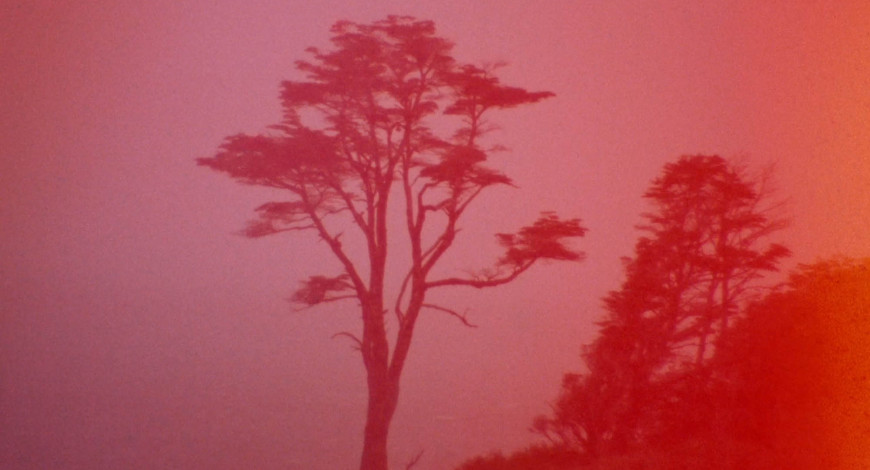
Under the title Ipsa sonant arbusta (“Even the woods themselves echo”), the exhibition brings together film and musical works from two practices that share, beyond a generational link, essential and intertwined visions of cinema and music.
Curated by Rosa Lleó and Manuel Cirauqui through the research platform einaidea, the exhibition features two films by Ana Vaz alongside a selection of recordings by her father, Guilherme Vaz, presented within a dedicated listening space. Archival materials that evoke the singular trajectory of the Brazilian musician, composer, and researcher accompany these works.
Ipsa sonant arbusta is conceived as an essayistic sketch—an open exercise that sets in dialogue the works of two creative figures and the sensitive, resonant worlds through which both move.
Ana Vaz (1986, Brazil) is an artist and filmmaker born in the country’s central-west region, a territory inhabited by the ghosts buried beneath its modernist capital, Brasília. Her filmography challenges and expands cinema as an art of the (in)visible and as an instrument capable both of dehumanising and of deepening connections with non-human or spectral forms of life. As a natural extension or consequence of her cinematic practice, her artistic activity also manifests through writing, critical pedagogy, installations, and collective walks.
Her films have been screened at festivals such as Berlinale – Forum Expanded (Germany); New York Film Festival (USA); Courtisane (Ghent, Belgium); and MoMA Doc Fortnight. They have received major awards at Locarno, Festival dei Popoli, Entrevues Belfort, FIDOCS Cinéma du Réel, Punto de Vista, Media City, and Frontier, and are part of the collections of CNAP (Centre National des Arts Plastiques), Kadist, FRAC Bretagne, and the Pinacoteca de São Paulo.
Her recent exhibitions include the 18th Istanbul Biennial (Istanbul, Turkey); Once within a time, 12th SITE SANTA FE (New Mexico, USA); Ana Vaz: Meteoro, solo exhibition at the Secession (Vienna, Austria); O que aconteceu ainda está porvir, solo exhibition at Cinema Batalha (Porto, Portugal) and Solar (Vila do Conde, Portugal); Do you believe in ghosts? – 24th Prix Pernod Ricard, group exhibition at the Fondation Pernod Ricard; It Is Night in America, solo exhibition at Jeu de Paume (Paris, France), Pivô (São Paulo, Brazil), and Escola das Artes (Porto, Portugal); Shéhérazade, la nuit, group exhibition at the Palais de Tokyo (Paris, France); and Penumbra, group exhibition at the Complesso dell’Ospedaletto (Venice, Italy).
Guilherme Vaz (Araguari, Minas Gerais, 1948 – Rio de Janeiro, 2018) was a Brazilian artist, thinker, and experimental musician. A pioneer of conceptual art in Brazil, he was also a key figure in audiovisual composition and sound art.
For decades, he explored the cultural roots of the Brazilian people, working with communities in the sertão of the central-west and with Indigenous groups in the north of the country. In addition to his broad recognition in the local context, he took part in major international exhibitions such as Information at MoMA, New York (1970), and the 8th Paris Biennale (1973).
Alongside his work in the visual arts, Guilherme Vaz composed scores for more than 60 Brazilian feature films. As a musician, conductor, and composer, Vaz introduced musique concrète into Brazilian cinema, in films such as Fome de amor (1968) by Nelson Pereira dos Santos and O anjo nasceu (1969) by Júlio Bressane. The CCBB in Rio de Janeiro dedicated a retrospective to him Uma fração do infinito (“A Fraction of Infinity”), in 2016.
In collaboration with Loop Barcelona and einaidea