
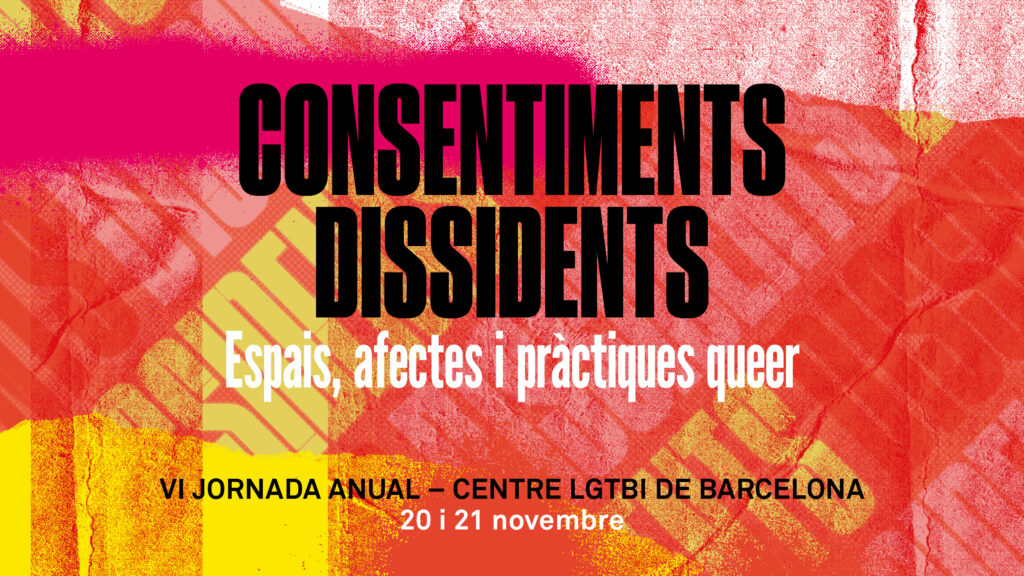
The Barcelona LGBTI Centre is organising a meeting on 20 and 21 November entitled “Dissident consent. Queer spaces, affection and practices”, as part of its sixth annual meeting.
The meeting looks at consent and its relationship with queer spaces, affection and practices. Taking queer experiences as a starting point, we’ll discover how these not only displace the heterosexual thread of the debate on consent, but also offer other narratives in terms of pleasure, risk and play.
The meeting will be organised into various round tables, as well as two bodily workshops. We’ll start from the body to rethink consent and its interaction with spaces, desire and agency.
The event has been jointly organised for the Barcelona LGBTI Centre as part of its sixth annual meeting; Zonas grises, a laboratory on critical consent launched by the researchers Elisenda Díaz and Magda Vaz and the research group “Cos i textualitat” at the Universitat Autònoma de Barcelona. The meeting is supported by the Universitat Autònoma de Barcelonaand the ICREA research foundation.
The event is conceived as a space for meeting, reflection and debate between academia, public policies and activism.
The full programme for the event will be announced on 6 November, on the LGBTI Centre’s website and social media. Participation in the round tables at the annual meeting is free and open to all. Places for the workshops are limited and require advance booking (registration opens on 6 November).
Zonas grises and the research group “Cos i textualitat”, from the Universitat Autònoma de Barcelona already organised the meeting “Consent beyond the norm”, at the LGBTI centre on 26 February 2025. The event was a starting point for posing the first questions based around the consent of dissident experiences and bodies.
An open and present debate
Consent has been at the centre of various debates since the 70s, bringing important theoretical, legal and cultural changes, all affecting our perception. Yet the concept of consent is linked to a white and heterosexual cis framework, based on the main debates on heteropatriarchal oppression.
Even though there have been transformations, such as the development of a culture of consent and various legislative changes that have meant a collective improvement in the capacity of consent, this notion of consent still does not include sexual or gender dissidence or an intersectional vision that integrates other means of inequality such as functional or corporal diversity, race or class.
In a context of violation of sexual rights, criminalisation of sexual and gender dissidence and strong social inequalities, where the global far right seeks to drive moral panic and reconfigure the political panorama to consolidate the hierarchies of power, consent can also be a tool for transformation.
Although the debate on consent has polarised positions in the last few years, this event seeks to get away from confrontation and bring ideas to the debate, adding reflections and exploring other perspectives.