
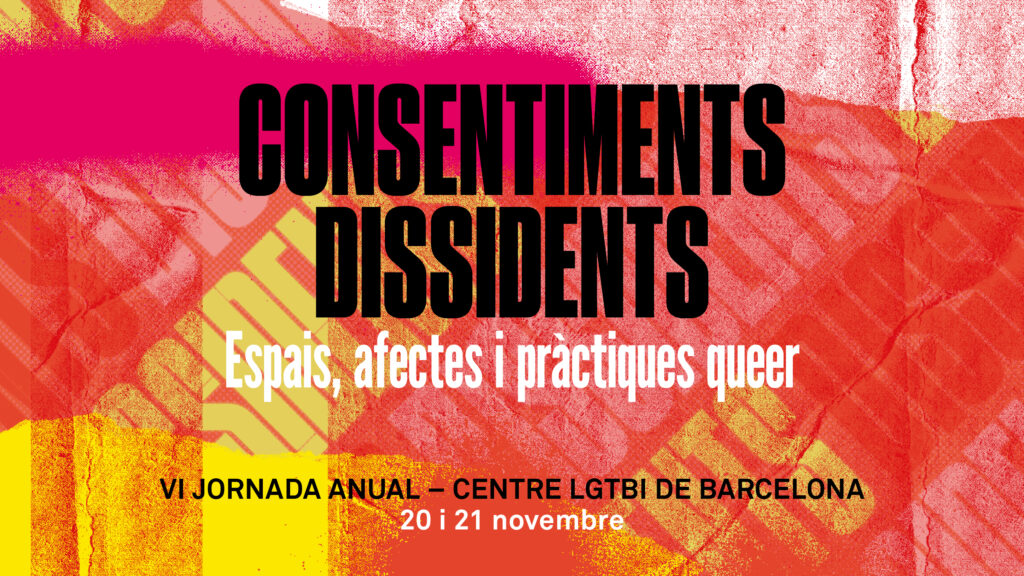
Sexual ethics in a post #MeToo world; desire, consent and pacts in lesbian, transfeminist and + sex spaces; the politics of queer desire; pro-sex feminism confronted by the far right or alliances to rethink bodies and consent will be some of the themes discussed at the 6th Annual Conference of the Barcelona LGTBI Centre, entitled “Dissident Consent. Queer spaces, affection and practices”.
The Conference will begin on Thursday 20 November with an institutional opening speech with Carme Font, director of Cos i textualitat research group; Elisenda Díaz, creator -together with Magda Vaz- of Zonas Grises consent lab, an independent research project and Miriam Solá, director of the Barcelona LGBTI Centre.
The inaugural conference “Consent In The Dark: Sexual Ethics in a Post-#MeToo World” will then be held, rethinking how sexual consent is expressed in action.
At this talk, sociologist Trevor Hoppe will question how popular models, such as “enthusiastic consent,” reflect white, heterosexual experiences. In contrast, queer communities have created their own ways of negotiating desire, boundaries, and safety over the years. The conference will be held in English and simultaneously interpreted into Catalan.
The second round table look at the experiences and practices that are reconfiguring transfeminist lesbian sex spaces. What do these spaces enable in terms of pleasure, pacts, and dissent? What taboos are being disarmed thanks to certain practices? This occasion invites participants to think of consent not only as an agreement, but as a defined, desiring, and collective practice, as a space to share strategies, tensions, and pleasures that arise when play becomes a political tool.
This idea of consent as a political space, beyond the legal or moral framework, will also be analysed from a queer perspective at the round table “Politics of queer desire: consenting, caring, resisting”, on Friday 21 November at 10.30 am. This space aims to look at the relationships of power, vulnerability and care in sexual practices between men.
From a transfeminist and queer perspective, the tensions between non-normative pleasure, desire and domination will be addressed, as well as the ways in which consent can reproduce or challenge patriarchal logic. The aim is to open up a critical debate on how queer fantasies of pleasure can result in situations of violence as well as practices of resistance, reappropriation and collective care.
The workshop will then propose a series of alliances that transcend the limits of established rules to rethink bodies and consent from outside white cis-heteronormativity: including but not limited to racialised, intersex, trans, fat or queer bodies. We will analyse how the structural relations of gender, race and class favour certain practices and certain bodies, while excluding those who do not fit into the norm. Which bodies does the system propose as desirable and desiring? What place do sexual and gender dissidences occupy within this logic of alienation and consumption? We will look at the violence of the neoliberal regime on our bodies, with a view to recognising desire as an emancipatory force.
Finally, the last round table will consider the role of pro-sex feminism in confronting the rise of the far right. From the close relationship between consent and agency, we will address the practices and discourses of sexual and gender dissent as acts of resistance in a context where the far right seeks to promote moral panic and reconfigure the political landscape.
Consult and download the full schedule here.
Both the inaugural conference and the round tables will be interpreted in Catalan Sign Language. Once the conference has ended, they will be available for viewing on the LGTBI Centre of Barcelona’s YouTube channel.
The LGTBI Centre of Barcelona’s facilities are accessible for wheelchair users. Throughout the Conference, a calm space will be available for all participants.
Participation in the conferences is free of charge until capacity is met. To participate in the practical workshops, prior registration is required. Places are limited.
The conference has been jointly organised by the LGTBI Centre of Barcelona as part of the framework of its 6th Annual Conference; Grey areas, a critical consent laboratory promoted by researchers Elisenda Díaz and Magda Vaz and the research group “Cos i textualitat” at the Autonomous University of Barcelona. The meeting is supported by the Universitat Autònoma de Barcelona and the ICREA research foundation.
