Barcelona was the venue of the final event in the PoDIUM project on connected and cooperative mobility.
The event brought together experts, operators, public administrations and tech centres from around Europe.
Barcelona was the European epicentre of connected, cooperative and automated mobility (CCAM) when it hosted the final event of the PoDIUM project, an initiative funded by Horizon Europe whose goal is to promote a new generation of physical and digital infrastructures for connected, cooperative traffic management, with the IMI as a partner.
The IMI has participated in improving interoperability following the European standards between the Manager’s Office for Mobility and for Firefighters, fulfilment of the security and data protection regulations and improvements in the green corridor.
At the event opening, Àngel López, coordinator of the Manager’s Office for Mobility, the other Barcelona City Council partner, welcomed participants and underscored Barcelona’s commitment to a safer, more efficient and more sustainable mobility model aligned with European smart city policies. He stressed the lack of knowledge of how autonomous mobility is going to evolve, as well as whether the changes it entails will be accepted by citizens. Finally, he mentioned the improvement to the green corridor (traffic lights) for emergency vehicles.
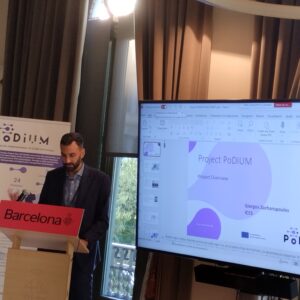
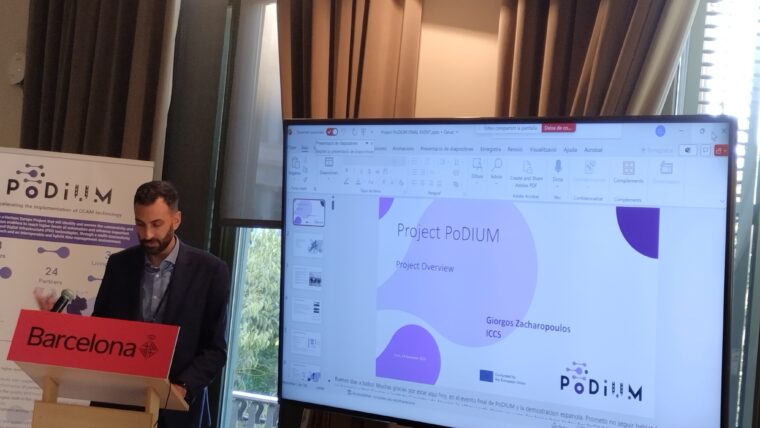
The project coordinator, Giorgos Zacharopoulos, emphasised the importance of the project, which has enabled cooperation among connected vehicles in a real traffic environment, edge computing (at street/motorway level) and the confidence and security of the data transmitted.
At midday, a panel discussion moderated by Míriam Alvarado, the director of Digital Transformation of Infrastructures and Urban Planning (IMI), featured experts from different sectors debating the challenges of the real rollout of CCAM technologies.
This panel discussion highlighted current infrastructures’ lack of preparation, which involves not only technology but also business intelligence, as well as the obstacle posed by a highly diverse yet inflexible European regulatory framework. The participants highlighted the importance of secure, transparent data governance and of quantifying the impacts of the new technologies, while stating that public-private cooperation, innovation and standards are crucial in overcoming these challenges and working towards more connected, autonomous mobility.
In situ demonstration
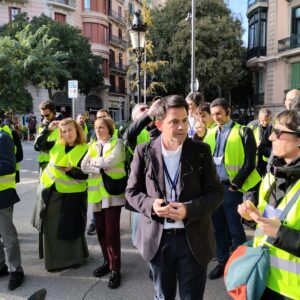
This work has led to new digital capacities that were put on display during the urban demonstration held in the afternoon on the corner of Gran Via and Girona.
The Barcelona pilot captured participants’ attention due to its focus on a physical and digital infrastructure geared at vulnerable users and high-priority vehicles, two extremely important areas for cities that seek to improve road safety.