
The IMI takes part in Catalonia ICT Day 2025
Experts and institutions discuss technological sovereignty and digital innovation with the IMI playing a notable part.
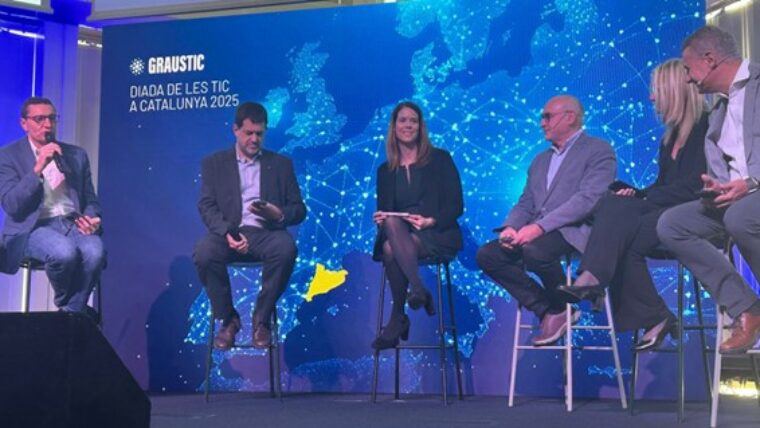
The Torre Diagonal hosted the ONE FÒRUM activity for Catalonia ICT Day on 12 and 13 November, with the programme Technological sovereignty “Europe’s time, Catalonia’s opportunity”, a leading event that brought together experts, institutions and companies to discuss the big challenges of technological sovereignty and digital innovation.
In a context of global commerce tensions and the need for technological independence in Europe, the session highlighted Catalonia’s capacity for consolidation as a tech hub for southern Europe, addressing key questions such as the country’s capacity to develop its own digital infrastructures, data governance, the independence of critical systems and driving the knowledge economy.
The Municipal Institute of Information Technology (IMI) played a notable part in this edition:
- Emili Rubio, the head of the IMI, took the role of interviewer on Wednesday 12, from 9.20 am to 9.55 am, in one of the central conversations together with Albert Tort, Secretary of Telecommunications and Digital Transformation with the Government of Catalonia. They discussed various matters, including the CPD making reference to the Macropou project, and the imminent publication in January of the government measure to adopt AI at Barcelona City Council. The session also highlighted the large volume of current collaboration between the public administrations.
- Patricia Moreno, director of innovation and technology at the IMI, was a speaker in session 3, “Intelligent Administration: AI and innovation in public service”, held on 12 November from 10 am to 11 am. She shared the experience of the Catalan administration in the application of disruptive technologies, highlighting how AI, smart automation and advanced data management help with the evolution towards proactive, efficient and people-centred models.
The meeting addressed key questions such as data governance, independence in critical systems, the promotion of the knowledge economy and the applicability of generative AI in sectors such as health, education and industry. There was also a special space for quantum technologies, coinciding with the International Year of Quantum Science.
