
Interview on Milan's Air and Climate Plan
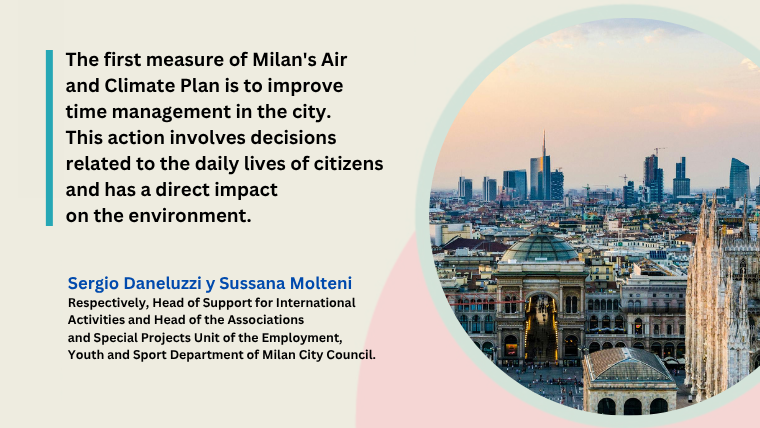
Sergio Daneluzzi and Sussana Molteni are part of the Employment, Youth and Sport Department of the Milan City Council. Specifically, they hold the positions of Head of International Activity Support and Head of the Associations and Special Projects Unit, respectively.
Together, they work on the Air and Climate Plan for the city of Milan, which aims to reduce air pollution, tackle the climate emergency, and protect the health of the population and the environment. The first measure of the plan is to improve time management in the city. This action involves decisions related to the daily lives of citizens and has a direct impact on the environment.
1. To begin with, a little context. What is the relationship between time use and climate change, and why have you addressed it in the Air and Climate Plan? What criteria or evidence did you take into account to identify this relationship?
Italy has a long tradition of urban policies on time, the result of social and political debate driven by women in public administration, politics, trade unions, and academia in the late 1980s. The Milan City Council was one of the first in Italy and Europe to develop urban policies on time through a Timetable Plan (1994), thanks to a national law that gave the mayor’s office the authority to coordinate the schedules of public and private services. These policies have always had an intersectoral approach, covering multiple areas of public intervention.
In recent decades, Milan has promoted numerous measures to improve the well-being of its citizens from the perspective of time policies. Especially during the COVID-19 pandemic, thanks to constant dialogue with public and private actors, the City Council approved adaptation, strategies, and guidelines that reinforced greater awareness of the need to harmonise time and urban rhythms to improve sustainability and quality of life.
In this regard, the Air and Climate Plan is a key tool for reducing air pollution and addressing the climate emergency, to protect health and the environment. The first measure of the Plan is committed to better time management in the city, which has an impact on the climate and air quality, as it involves decisions related to the daily lives of residents.
2. What are the main areas of action of the measures envisaged in the Plan that impact the use of time in the city of Milan, and how does the design of time policies contribute to reducing the impact of climate change?
Four main areas of action have been identified. The first is proximity and decentralisation: residents must be able to meet their basic needs without having to travel long distances, whether by car or other means of transport. This approach is based on the concept of the “15-minute city”, which proposes that everyone should be able to reach the various places of interest in the municipality – shops, schools, or public services – on foot or by bicycle in a maximum of 15 minutes.
The second is multifunctionality, which means that people must be able to meet multiple needs in the same space. For example, a library can house various types of documents and also host social events.
The third is digitalisation, which includes all policies aimed at facilitating citizens’ access to online resources and services, avoiding unnecessary travel and saving time.
Finally, flexibility refers to all measures that promote work-life balance, focusing on working and study hours, through formulas such as teleworking, flexible hours, and extended school hours.
3. In the Plan, you have classified time policies according to whether they are adaptation policies, policies to mitigate the effects of climate change, or policies that impact air quality. Why did you establish these criteria, and why do you believe they are important
Identifying these criteria was essential to evaluating the real impact of individual actions. Naturally, adaptation refers to all actions and strategies aimed at enabling people to better cope with the effects of climate change. Mitigation refers to actions and strategies that would have a direct impact on climate change and, therefore, promote an improvement in overall conditions. Air quality encompasses all actions aimed at controlling air pollution.
Although many actions are relevant in more than one of these dimensions, this approach allows for a better understanding of the results of each specific practice or policy.
4. What role do institutions, businesses, organisations, and citizens play in achieving the Plan’s objectives?
A plan of this magnitude can only be implemented if a large majority of stakeholders are involved from the outset. In this case, all parties have been involved: trade unions, business associations, universities, and, above all, citizens. The relevant municipal departments, under the supervision of the Climate and Energy Department, as well as the Polytechnic University of Milan, have also been involved.
In addition, a permanent body, coordinated by a steering committee and with the participation of the Citizens’ Climate Assembly, worked on the action plan for 2024 and drew up recommendations for advancing its objectives. This is a new local framework that supports debates and projects on employment opportunities and working conditions, and, in this context, has promoted the municipality’s adherence to the Labour Pact, a specific and collaborative policy involving the joint participation of businesses and trade unions.
5. The strategic focus of the ‘Conscious Citizens’ plan is to encourage citizens to adopt a conscious and sustainable lifestyle. How do you plan to address the lack of time or time poverty suffered by the most vulnerable groups, who may find it more difficult to adopt a healthier lifestyle in the environment?
This is a fundamental task and one of the most critical aspects of this whole initiative. We are emphasising communication at all levels to ensure that the message reaches as many people as possible. We have a dedicated website, communication campaigns, printed information leaflets, and even an office dedicated to the project where anyone can go three times a week to request information, access individual and family best practices, and receive advice. We also offer support in comparing the energy prices offered by different suppliers and other practical information.
6. What results do you expect to achieve in the medium and long term with the implementation of the Plan?
The medium-term objective of the Plan, by 2030 – is to achieve a 50% reduction in the concentration of pollutants in the air compared to 2005 data. In the long term, by 2050 – the aim is to achieve air pollution levels in line with WHO recommendations, as well as carbon neutrality, while keeping urban temperature increases below 2°C.
7. Could you highlight the main results achieved so far with the implementation of your Plan? Have the policies adopted had a positive impact on mitigating environmental effects in the city of Milan? What are the next steps you plan to take?
The first comprehensive monitoring of the Plan, which began in 2023, is still ongoing, so we do not yet have official data. We will be able to answer this question soon. We are confident that all the measures implemented will yield significant results, although we recognise that the challenge is very demanding.
8. We can say that cities play a fundamental role in mitigating climate change. Do you think your Plan could be replicated in other European cities such as Barcelona? Which elements of the Plan do you think would be particularly transferable or inspiring for other municipalities?
We are confident that other large cities, such as Barcelona, have already implemented their strategies to address these same issues with reasonable success. However, we believe that the elements of our Plan are easily transferable to most European cities. In particular, the division of activities into four main categories and the criteria for adaptation, mitigation, and air quality can be very useful in any scenario.