
Presentation of the time policy evaluation tool at the Time Academy
Barcelona City Council presents its tool for analysing the implementation and impact of time policies in the city at the Time Academy, the first international academy on time policies.
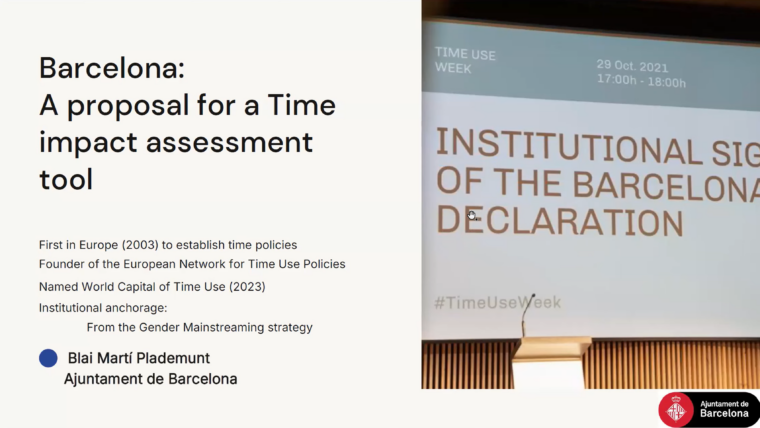
» Barcelona City Council presents its tool for analysing the implementation and impact of time policies in the city.
» The city council works on the premise that time is a public resource that needs to be redistributed in a fairer and more harmonious way, with the ultimate goal of eradicating time poverty.
The Time Academy is the first international academy on time policies. From the 30th of June to the 3rd of July, more than 300 people from 36 countries took part: professionals from local and regional government and other areas involved in the design and implementation of public policies.
The training included four sessions, given by experts with recognised track records from all over Europe, who addressed the key aspects of incorporating the time perspective into institutional governance: identification – design – implementation, and evaluation of time policies. Retrieve all the sessions on video.
On 1st of July, Barcelona, as a European benchmark in time policies, participated in the 2nd session of the Time Academy “Evaluating time policies through data-based evaluation systems”, to share its experience in the development of evaluation tools. Blai Martí, an expert from the Directorate of Feminism and LGTBI Services, was in charge of presenting the tool created by the city council to analyse the implementation and impact of time policies in the city.
The evaluation avoids unequal time distribution
Barcelona City Council works on the premise that time is another public resource, of a finite nature, which needs to be redistributed in a fairer and more harmonious way. This redistribution aims to eradicate the time poverty suffered by the citizens of Barcelona, which perpetuates and exacerbates existing inequalities.
To this end, a tool has been established that evaluates the uses of time proposed by a policy, regulation, or project, and recommends ways of redistributing it in a more balanced way. The council uses this evaluation tool in parallel with other mechanisms, such as gender or environmental evaluation.
The Barcelona City Council’s Time Policy Evaluation Toolkit
The evaluation tool developed is proactive and, in general terms, is based on two steps. Firstly, it diagnoses how time is currently used in a specific area of action of a project or policy (work time, time for care, time for mobility, time for social or political participation and personal time). Secondly, we estimate how these uses of time will change after the implementation of a policy, and whether it will contribute to reducing or increasing time inequalities. If the expected impact is negative, the policy is reformulated and re-evaluated until the result is positive. Once validated, monitoring indicators are established and the policy is deployed.
Time evaluation in action: school mobility
The City Council will test the initiative created with the pilot project “Let’s transform mobility”, carried out in 2023. The aim was to evaluate the impact of public policies on improving the use of time linked to school mobility.
The evaluation concluded that fostering the autonomy of children and young people in school activities has a positive impact: it frees up the time of the accompanying persons – usually women – to devote to other activities, and at the same time promotes a more active and healthy childhood.
Gender and time inequality in transport fares
During the session, Blai Martí also gave an exclusive presentation of an ongoing research project on gender inequalities and time use associated with transport fares and transport mobility.
Using the time evaluation tool, the City Council has detected various factors, including current time use, that need to be taken into account when designing policies to reduce these inequalities.
The mobility of care, which is mainly associated with women (who spend 2 hours and 23 minutes more per day than men on care tasks), is characterised by the following characteristics:
- multipurpose, linked to different types of care,
- unpredictable, with unplanned tasks,
- short but frequent,
- off-peak hours,
- related to specific infrastructures such as schools, hospitals, or nurseries.
This type of mobility is neither reflected in nor favoured by the city’s current transport fares.
Given this, the council proposes establishing flexible travel passes for fragmented and unforeseen mobility, applying hourly fares that avoid penalising journeys for care, and collecting systematic data on care mobility, a reality that is still barely visible.
Dossier del temps: “De la pobresa de temps al temps per a la vida”
The evaluation paper is presented in the time dossier “From time poverty to time for life. Theoretical Approaches and Practical Orientations”, published in 2023. The dossier, authored by Sònia Ruiz, Georgina Monge, Ana Paricio, and Blai Martí, sheds light on the reality and the faces behind time poverty, and offers useful tools so that institutions can better understand it and act effectively.