Barcelona City Council takes part in the Marmara Urban Forum
MARUF 2025 placed the right to time and time management policies on the agenda of cities around the world, highlighting them as key tools to improve equality, sustainability, efficiency, and health of citizens.
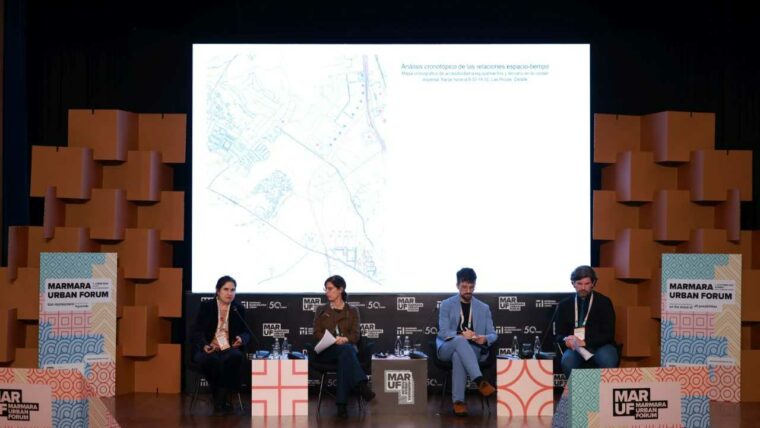
» Barcelona City Council participated in the Marmara Urban Forum 2025 (MARUF 2025), a biennial international meeting that brings together key urban actors from around the world to exchange good practices and design collective solutions addressing global challenges from a local perspective.
» MARUF 2025 placed the right to time and time management policies on the agenda of cities around the world, highlighting them as key tools to improve equality, sustainability, efficiency, and health of citizens. It hosted the session “Tick-Tock, Tick-Tock, Local Time Policies”.
» During the session, the City Council presented some of the initiatives developed to promote the right to time in the city: the Time Pact, the NUST Network of Companies, the Concilia service, the Caregiver Card, the “ Let’s Protect Schools” project, and the Advisory Service for Companies on Equality and Time Organization.
This October, Barcelona City Council participated in the Marmara Urban Forum “Cities developing solutions”, organised by the Union of Municipalities of Marmara (MMU), which was held from 1 to 3 October in Istanbul (Turkey).
The Forum serves as a meeting point for different urban actors from all over the world (public institutions, international organizations, local governments, NGOs, the private sector, universities and think tanks) that aims to promote the exchange of innovative and effective urban practices that offer long-term solutions to global challenges, crises and uncertainties from the local level.
Under the motto “On the edge of all possibilities”, MARUF 2025 invited speakers and attendees to reflect on and seek collective solutions to a wide range of urban challenges: disaster management, the climate crisis, mobility, governance, sustainable development, housing, artificial intelligence or time organization, the latter as a tool to enhance equality, sustainability, efficiency and health of citizens.
Tick-Tock, Tick-Tock, Local Time Policies
MARUF 2025 placed the right to time and time management policies on the agenda of cities around the world through the session “Tick-Tock, Tick-Tock, Local Time Policies”, with the participation of Barcelona City Council as a member of the Local and Regional Time Policies Network. The city was represented by Laura de Caralt, Head of Time Policy Management at the Directorate of Feminism and LGBTI Services.
The session, following up on a previous discussion about the right to time, showcased policies and practices that promote fair and efficient time use at the local level, aiming to build cities that respect citizens’ time.
Laura de Caralt introduced some of the good practices developed by Barcelona City Council, such as the Time Pact and the NUST Network, which are paradigmatic examples of co-production with the city’s economic and community networks.
The Time Pact is a city-wide agreement between the City Council and the social and economic organizations of the city in order to act together and achieve a healthier, more egalitarian, efficient and sustainable organization of time. On the other hand, the NUST Network — Network of Companies for a New Working Time — is a local network of companies and entities of different sizes and sectors aimed at promoting more efficient, sustainable organizational models that help reconcile work and personal life.
She also presented four essential municipal services designed to guarantee everyone’s right to time: the “Concilia” project, a free childcare and babysitting service to facilitate the reconciliation of work and personal life; the “Caregiver Card”, an initiative that aims to recognise the essential work of caregivers, offering them services and benefits that can facilitate their work and improve their quality of life; the “Let’s Protect Schools” project, a city-wide strategy to ensure that Barcelona’s schools have a public space that serves as a meeting point for children and their families, as well as for the neighbors; and the “Advisory Service for Companies on Equality and Time Organisation , which offers personalised and free support to help companies and organisations in Barcelona implement a new culture of working time that favours work-life balance, co-responsibility and well-being at work.
The Local and Regional Time Policies Network
The Local and Regional Time Policies Network is an international alliance of cities, metropolitan areas and regions representing more than 90 million people around the world.
Its objective is to make the right to time a reality through the exchange and promotion of time policies promoted both locally and regionally. The network includes around fifty institutions in Europe, America and Asia, including Barcelona, Milan, Strasbourg, Bogotá and Istanbul. Barcelona City Council has been part of the Executive Council since the network’s creation.