
Barcelona: Our City, Our Archives. The Documents of the City’s History
The Barcelona Municipal Archives is presenting the exhibition “Barcelona: our City, Our Archives. The Documents of the City’s history”, from 19 September (from 18.00 h) to 23 November 2025 at Saló del Tinell. Until the 25th of September, exceptionally, visitors will have the opportunity to see the Llibre Verd (Green Book) of Barcelona, one of the most important books of privileges of the city dating back to the 14th century and which is preserved at the Historical Archive of the City.
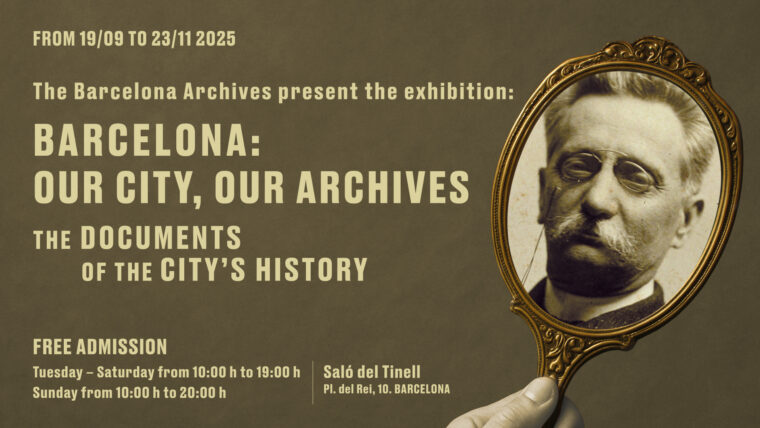
The title “Barcelona: Our City, our Archives” reflects the unbreakable connection between the city, the Municipal Archives and the people who, together, forge Barcelona’s story. Throughout our lives, we generate documents (when we are born, get married, register as city residents or interact with public institutions) that become part of the archives. The exhibition aims to make everyone feel like a protagonist, showing that the Archives are not an abstract construct, but a living and shared space that define us.
The exhibition focusses on the strength and singularity of original documents, with nearly a hundred pieces —between originals, facsimiles and reproductions— selected from the Municipal Archives’ holdings, which span more than 50 linear kilometres and date back to the 13th century. In a hyper-digitalised context, the exhibition highlights the tangible and unique value of these documentary accounts, which are the protagonists of the exhibition and which encourage visitors to connect with history through their materials and unique patrimonial value. This selection not only reflects the city’s evolution over many centuries, but also makes it clear that the Archives are a living and essential public service for the city’s people.
The exhibition is structured around four major conceptual areas that offer a comprehensive and diverse view of the city’s history through its documents:
- The Barcelona Municipal Archives: This area presents the Archives as an essential public service from their origins in the 13th century to the present day, highlighting their evolution in the digital age and their role in preserving the authenticity and accessibility of Barcelona’s memory. It also presents the values that define the Archives: accessibility, transparency, authenticity, memory, preservation, rights, restitution, identity, research and public service.
- Municipal governance throughout the centuries: This section explores the evolution of local governance, from the creation of the first autonomous city government in 1249 to the restoration of democracy in 1979 and the present. Documents such as the only preserved copy of the privilege granted by James I in 1249 and the Green Book dating to the 14th century illustrate Barcelona’s access to self-governance. It also includes references to institutions such as the carreratge system, the declaration of Sarajevo as the 11th district, records from the first democratic elections in 1979 and files on repression by Franco’s regime, examples of the city’s spirit of resistance.
- The city as a physical space: architecture, urban planning and public services: This section documents the urban transformation of Barcelona from the Gothic city nestled within its walls. Documents such as Wyngaerde’s 1563 Panoramic of Barcelona and the maps for the construction of the Eixample, as well as modernista projects by Gaudí and Puig i Cadafalch illustrate the dialogue between tradition and modernity. In addition, this section explores the management of public services (education, health, transport) over time, highlighting Barcelona’s aspiration to be an equitable city.
- Society: forms of work and social diversity: The final section focusses on people as protagonists of Barcelona’s history and explores forms of work and social diversity. From medieval guilds to the industrial revolution and contemporary globalisation, documents such as the Llibre del Consolat de Mar and records of workers’ strikes show how work has shaped Barcelona’s identity. The section also includes accounts of social activism, from the fight for women’s suffrage in 1933 to the sexual liberation demonstrations in 1977, which underline that Barcelona’s story is a human mosaic of experiences, dreams and resistance that aspires to make a more just and diverse city.
One final audiovisual piece presents the future projects of the Barcelona Municipal Archives.
The documents exhibited come from the centers of the Barcelona Municipal Archive: Photographic Archive of Barcelona, Historical Archive of the City of Barcelona, Contemporary Municipal Archive of Barcelona, and the municipal archives of the city’s ten districts.
The exhibition boasts a prime location at Saló del Tinell, a historic setting located in Plaça del Rei, part of the Barcelona History Museum and within the premises of the former Palau Reial Major. This space is not just a vessel, but an active element that enriches the story by physically and symbolically connecting the medieval past with the present of Barcelona’s people.
Exhibition organised by the Barcelona Municipal Archives and curated by Daniel Venteo.
Free Admission
Saló del Tinell (pl. del Rei, 10)
Museu d’Història de Barcelona
Opening: 19 September at 18.00 h
The exhibition will be open from 20 September to 23 November
Tuesday – Saturday
10.00 h to 19.00 h
Sunday
10.00 h to 20.00 h
What does this exhibition offer the city of Barcelona?
This exhibition plays a crucial role in the city, as it is aimed at the whole of society with clear goals:
- To educate people about the Archives and make them more accessible to all: The exhibition aims to educate visitors about the Barcelona Municipal Archives and their significance as an institution that has been at the service of the city for over seven centuries. Archives are not institutions exclusively for scholars, rather they are open to all members of the public and are a reflection of the daily lives of the people who make society possible.
- Promote a participatory and critical city community: It is an invitation to discover (and, in many cases, rediscover) Barcelona, reflect on its formation and its present, and promote a participatory, active and critical city community.
- Highlight the value of the Archives as a pillar of democracy: It showcases the unsung, ongoing work of generations of archivists. The Archives play a fundamental role in guaranteeing free access to information, transparency in public management and the preservation of documentary heritage. The exhibition emphasises their role as a tool for a democratic and participatory society, serving as a pillar that protects individual rights and builds the narratives of Barcelona’s history.
- Connect with identity and collective memory: The “our” in the title emphasises that the Archives are a collective construction built by the city community as a whole. This close-up look at the city through its people is a mirror that will help visitors recognise themselves and their identity in the documents that explain our past and present.
“Barcelona: our City, Our Archives” is part of the ICA Barcelona 2025 International Archives Congress, which will be held from 27 to 30 October 2025 at the Barcelona International Convention Centre. It is expected to attract more than two thousand attendees from around the world, making “Barcelona: our City, Our Archives” a key piece in the cultural programme that will accompany the event. This reinforces the exhibition’s aim of making the Archive accessible and relevant, offering international visitors a direct and tangible vision of how the city construes and values its documentary heritage as well as contributing to the global dialogue on the future of archival science.