Logo of Barcelona City Council

Select language

  • Català
  • Castellano
  • English

Other Barcelona City Council websites

The City Council
Contact
Procedures
Work at the City Council
News
Agenda
Map
Getting there
Skip to main content

Arxiu Municipal de Barcelona

Home
Menu navigation instructions

Instructions for screen readers and keyboard users

This menu requires arrow keys to be able to use it. The menu has up to three levels:

  • First level: main menu options
  • Second level: sub-options for elements from the first level
  • Third level: sub-options for elements from the second level

Browsing instructions:

  • Browse using the horizontal arrow keys on the first level of the menu.
  • Display and browse on the second level using the vertical arrow keys.
  • Use the Escape key to get back to the first level.
  • Use the right arrow key to display the third level.
  • Browse the third level by using the vertical arrow keys.
  • Use the Escape key to get back to the second level.
  • Alternatively, use the Enter key to display any level.
  • About us
    About us
    • Who we are
    • How we are organised
      • How we are organised
      • How we are organised
      • Archives Master Plan
      • Annual reports
      • Rights and commitments
    • History of the Archives
      • History of the Archives
      • History of the Archives
      • Medieval origins
      • Historical and administrative fonds
      • Archives Organisation Project
      • Change of century
    • Information and opening times
    • How to get there
    • Archive centers
    • Collaborate with us
  • Consult
    Consult
    • Consult the documents
    • FAQ
  • Services
    Services
    • Personalised advice
    • Reproduction of documents
    • Training and dissemination activities
    • City Council service
  • Activities and dissemination
    Activities and dissemination
    • Find out about our activities
    • Guided visits
    • Virtual exhibitions
    • Publications
    • Archive itineraries
    • International Archives Week
    • Educational activities
    • Learn with the Archives
    • Research conference
  • Records management
    Records management
    • Summary of records
    • Classification frameworks
    • Description method
    • Municipal Commission on Records Access and Appraisal
    • Conservation and access calendar
    • e-Government
    • Rules and regulations
Menu navigation instructions

Instructions for keyboard users

This menu requires arrow keys to be able to use it. The menu has up to three levels:

  • First level: main menu options
  • Second level: sub-options for elements from the first level
  • Third level: sub-options for elements from the second level

Browsing instructions:

  • Browse using the vertical arrow keys on the first level of the menu.
  • Use the right arrow key to display the second level.
  • Browse on the second level using the vertical arrow keys.
  • Use the Escape key to get back to the first level.
  • Use the right arrow key to display the third level.
  • Browse the third level by using the vertical arrow keys.
  • Use the Escape key to get back to the second level.
  • Alternatively, use the Enter key to display any level.
  • About us
    About us
    • Who we are
    • How we are organised
      • How we are organised
      • How we are organised
      • Archives Master Plan
      • Annual reports
      • Rights and commitments
    • History of the Archives
      • History of the Archives
      • History of the Archives
      • Medieval origins
      • Historical and administrative fonds
      • Archives Organisation Project
      • Change of century
    • Information and opening times
    • How to get there
    • Archive centers
    • Collaborate with us
  • Consult
    Consult
    • Consult the documents
    • FAQ
  • Services
    Services
    • Personalised advice
    • Reproduction of documents
    • Training and dissemination activities
    • City Council service
  • Activities and dissemination
    Activities and dissemination
    • Find out about our activities
    • Guided visits
    • Virtual exhibitions
    • Publications
    • Archive itineraries
    • International Archives Week
    • Educational activities
    • Learn with the Archives
    • Research conference
  • Records management
    Records management
    • Summary of records
    • Classification frameworks
    • Description method
    • Municipal Commission on Records Access and Appraisal
    • Conservation and access calendar
    • e-Government
    • Rules and regulations

District Municipal Archive of L'Eixample

  • History of the Archive
  • What records do we keep?
  • Educational activities
    • Get to know the Eixample District Municipal Archives
    • Itinerary along Dreta de l'Eixample’s iconic buildings
  • Where to find us
  1. Home
  2. / District Municipal Archives
  3. / L'Eixample

History of the Archive

From Casa Elizalde to Consell de Cent, and from seven repositories to Illa Waldorf

The Eixample Archives has been stored in different places, the first of which was Casa Elizalde, Carrer de València, 202, between 1990 and 1996.

From 1995 to 2011, the Archives' records were kept in seven repositories around the city, with two of them on the second level of the Mercat de la Concepció basement (C/ Aragó, 315) and another on the ground floor of a building at Gran Via de les Corts Catalanes, 732. A fourth was on the first floor of a property at Carrer de Padilla, 321, while the other three were in different parts of the Eixample District Municipal Council headquarters, at Carrer d’Aragó, 311.

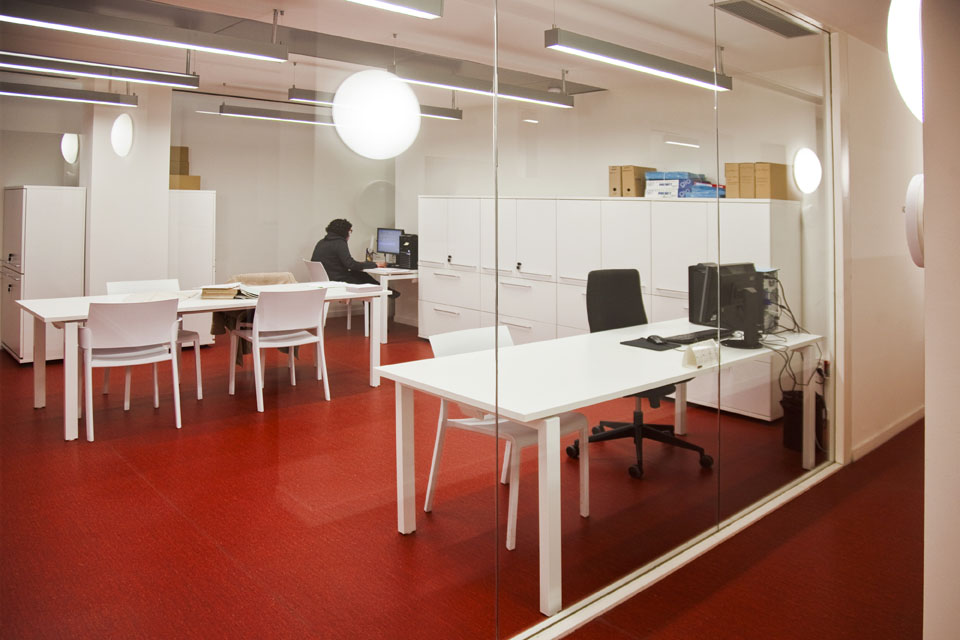
The Archives finally moved to its new headquarters at C/ Calàbria, 38, on 11 January 2011. They occupy part of the underground floor of the Illa Waldorf complex, sharing it with the Sant Antoni neighbourhood Social Services Centre, where the Waldorf Cinerama used to be.

All the records, until then dispersed, are now kept here in a single repository which has all the latest technical, functional, environmental and security requirements of an archive centre, in a total surface area of 840 m2, with 2,642 metres of shelving.

A cinema archive

The Waldorf Cinerama was news in 1966, following the remodelling of the Mistral, a neighbourhood cinema that had entertained Sant Antoni residents from the pre-war years to 1962.

The Waldorf closed for good in 2003 and Barcelona City Council acquired the premises with the intention of creating new facilities for the Eixample district. A social services centre was installed in the space previously occupied by the projection rooms, along with the Eixample District Municipal Archives, and a small area was landscaped for the block interior.
Note for screen reader users. This gallery shows one element, which can be an image or a video. Use the controls from the ‘Gallery Controls’ area to show the previous or the next element. You can also click on the element you wish to visualise.
An image of the reference room at the AMDE which is completely white, with tables, cabinets and a person seated at one of the tables in front of a computer.

The AMDE’s reference room, which has been located in the basement of the Illa Waldorf complex since January 2011. Carme García Navarro

Slide 1 of 1
Barcelona City Council logo
  • Accessibility
  • Legal notice
  • Contact us