Logo of Barcelona City Council

Select language

  • Català
  • Castellano
  • English

Other Barcelona City Council websites

The City Council
Contact
Procedures
Work at the City Council
News
Agenda
Map
Getting there
Skip to main content

Arxiu Municipal de Barcelona

Home
Menu navigation instructions

Instructions for screen readers and keyboard users

This menu requires arrow keys to be able to use it. The menu has up to three levels:

  • First level: main menu options
  • Second level: sub-options for elements from the first level
  • Third level: sub-options for elements from the second level

Browsing instructions:

  • Browse using the horizontal arrow keys on the first level of the menu.
  • Display and browse on the second level using the vertical arrow keys.
  • Use the Escape key to get back to the first level.
  • Use the right arrow key to display the third level.
  • Browse the third level by using the vertical arrow keys.
  • Use the Escape key to get back to the second level.
  • Alternatively, use the Enter key to display any level.
  • About us
    About us
    • Who we are
    • How we are organised
      • How we are organised
      • How we are organised
      • Archives Master Plan
      • Annual reports
      • Rights and commitments
    • History of the Archives
      • History of the Archives
      • History of the Archives
      • Medieval origins
      • Historical and administrative fonds
      • Archives Organisation Project
      • Change of century
    • Information and opening times
    • How to get there
    • Archive centers
    • Collaborate with us
  • Consult
    Consult
    • Consult the documents
    • FAQ
  • Services
    Services
    • Personalised advice
    • Reproduction of documents
    • Training and dissemination activities
    • City Council service
  • Activities and dissemination
    Activities and dissemination
    • Find out about our activities
    • Guided visits
    • Virtual exhibitions
    • Publications
    • Archive itineraries
    • International Archives Week
    • Educational activities
    • Learn with the Archives
    • Research conference
  • Records management
    Records management
    • Summary of records
    • Classification frameworks
    • Description method
    • Municipal Commission on Records Access and Appraisal
    • Conservation and access calendar
    • e-Government
    • Rules and regulations
Menu navigation instructions

Instructions for keyboard users

This menu requires arrow keys to be able to use it. The menu has up to three levels:

  • First level: main menu options
  • Second level: sub-options for elements from the first level
  • Third level: sub-options for elements from the second level

Browsing instructions:

  • Browse using the vertical arrow keys on the first level of the menu.
  • Use the right arrow key to display the second level.
  • Browse on the second level using the vertical arrow keys.
  • Use the Escape key to get back to the first level.
  • Use the right arrow key to display the third level.
  • Browse the third level by using the vertical arrow keys.
  • Use the Escape key to get back to the second level.
  • Alternatively, use the Enter key to display any level.
  • About us
    About us
    • Who we are
    • How we are organised
      • How we are organised
      • How we are organised
      • Archives Master Plan
      • Annual reports
      • Rights and commitments
    • History of the Archives
      • History of the Archives
      • History of the Archives
      • Medieval origins
      • Historical and administrative fonds
      • Archives Organisation Project
      • Change of century
    • Information and opening times
    • How to get there
    • Archive centers
    • Collaborate with us
  • Consult
    Consult
    • Consult the documents
    • FAQ
  • Services
    Services
    • Personalised advice
    • Reproduction of documents
    • Training and dissemination activities
    • City Council service
  • Activities and dissemination
    Activities and dissemination
    • Find out about our activities
    • Guided visits
    • Virtual exhibitions
    • Publications
    • Archive itineraries
    • International Archives Week
    • Educational activities
    • Learn with the Archives
    • Research conference
  • Records management
    Records management
    • Summary of records
    • Classification frameworks
    • Description method
    • Municipal Commission on Records Access and Appraisal
    • Conservation and access calendar
    • e-Government
    • Rules and regulations

District Municipal Archive of Gràcia

  • History of the Archive
  • What records do we keep?
    • Private Works Licenses
  • Educational activities
    • Get to know the Gràcia District Municipal Archives
    • The Annual Festival. Games, snacks and traditional dances in the Gràcia of yesteryear
    • The Gràcia tramway system
    • The underground water network of Vila de Gràcia
    • Itinerary through Gràcia: cultural life and the associations movement in Vila de Gràcia
  • Teaching resources
    • What was the metro like before?
    • A mysterious disappearance
    • And the bombs rained down
    • When there is nothing to eat
    • Long live the war
  • Publications
  • Where to find us
  1. Home
  2. / District Municipal Archives
  3. / Gràcia

What records do we keep?

Municipal fonds

This consists of the records of the various past and present local government bodies and municipal authority offices in their geographic area.

We manage and conserve municipal records from various historical periods:

  • The old Gràcia Council fonds (1870-1897), as the documents from 1850 to 1870 were destroyed in the Reservists’ revolt of April 1870.
  • Barcelona City Council fonds (1900 to the present), although most of the records date from 1984 and are based on the powers awarded to the district municipal councils that year.

The old Gràcia Council fonds is very useful for studying the town of Gràcia and local administration in the second half of the 19th century, as Gràcia was constituted as an independent municipality in 1850, with different boundaries to the current district. One of the most interesting sections is Urban Planning and Works which, for example, includes work on extending the Eixample, the García Faria sewerage system project and the files on private building work which clearly reveal the construction boom at the end of the 19th century. The Education, Charity and Supplies sections also contains significant records.

As regards the Barcelona City Council fonds, the oldest records come from the Deputy Mayor’s Office and the Municipal Council of District VIII, which functioned from 1900 to 1979. Notable among them are the municipal residents’ registers (padrons) up to 1920, although the number of records is small because neither the Deputy Mayor nor the Council had many functions.

Finally, it is worth mentioning the records from the current period, dating from 1984 with the creation of the District Municipal Council. This made it possible to study the administrative life of the district from then on up to the present day. The most consulted series are licences for business activities, major works and urban projects. We should also mention the 994 photo reportages and 1,352 photographs, in all 7,154 positives, 5,304 negatives and 546 slides, which show us the events and festivals held in the district from 1977 to 2006.

Private fonds

We have various fonds from private sources, most of them donated. Documentation generated by the associations themselves, notably the fonds of the Associació de Veïns del Camp d’en Grassot, the Cercle Filatèlic i Numismàtic de Gràcia, the Societat Obrera l’Artesa, the Espeleo Club de Gràcia, the Associació Esportiva i Cultural CADECA, the Associació de Veïns de la plaça del Sol and the Federació Catalana de Lluita.

Collections

Out of all of these, we can highlight the Club Excursionista de Gràcia Collection, which combines numerous graphic and photographic documents, specialist and newspaper libraries, and a range of heritage and personal fonds, all linked to the Vila de Gràcia from the 17th to the 20th centuries. This collection is indispensible for studying Gràcia’s associations and its leading figures.

It includes over 4,000 photographs that take you on a journey through the graphic and photographic image of the town, with an extensive photographic collection of widely varying images, such as the tram stop, already electrified, at the Josepets church in 1912, or the Abaceria market in the 1930s, as well as a collection of posters, notably the one announcing a “Grand Ball at the Teatre Bosc” from 1910, or the one advertising “Esperanto Lessons” from 1933.

We should also mention the “Ramírez Fonds" collection. Albums of the Festa Major de Gràcia”, a collection of great interest that chronicles the big annual local festival from the 1950s and 1960s. The photo collection of Armand Guart (1943-1947). The collections of programmes for the festa major from 1898 to 2007 and for the St Medir festival from 1908 to 2008.

We also have an auxiliary library, as well as magazines and periodicals produced in Gràcia which, in many cases, have come from residents’ associations and other entities.

If you want to find out all the information we have at the Gràcia Archives, consult the fonds table.
Note for screen reader users. This gallery shows one element, which can be an image or a video. Use the controls from the ‘Gallery Controls’ area to show the previous or the next element. You can also click on the element you wish to visualise.
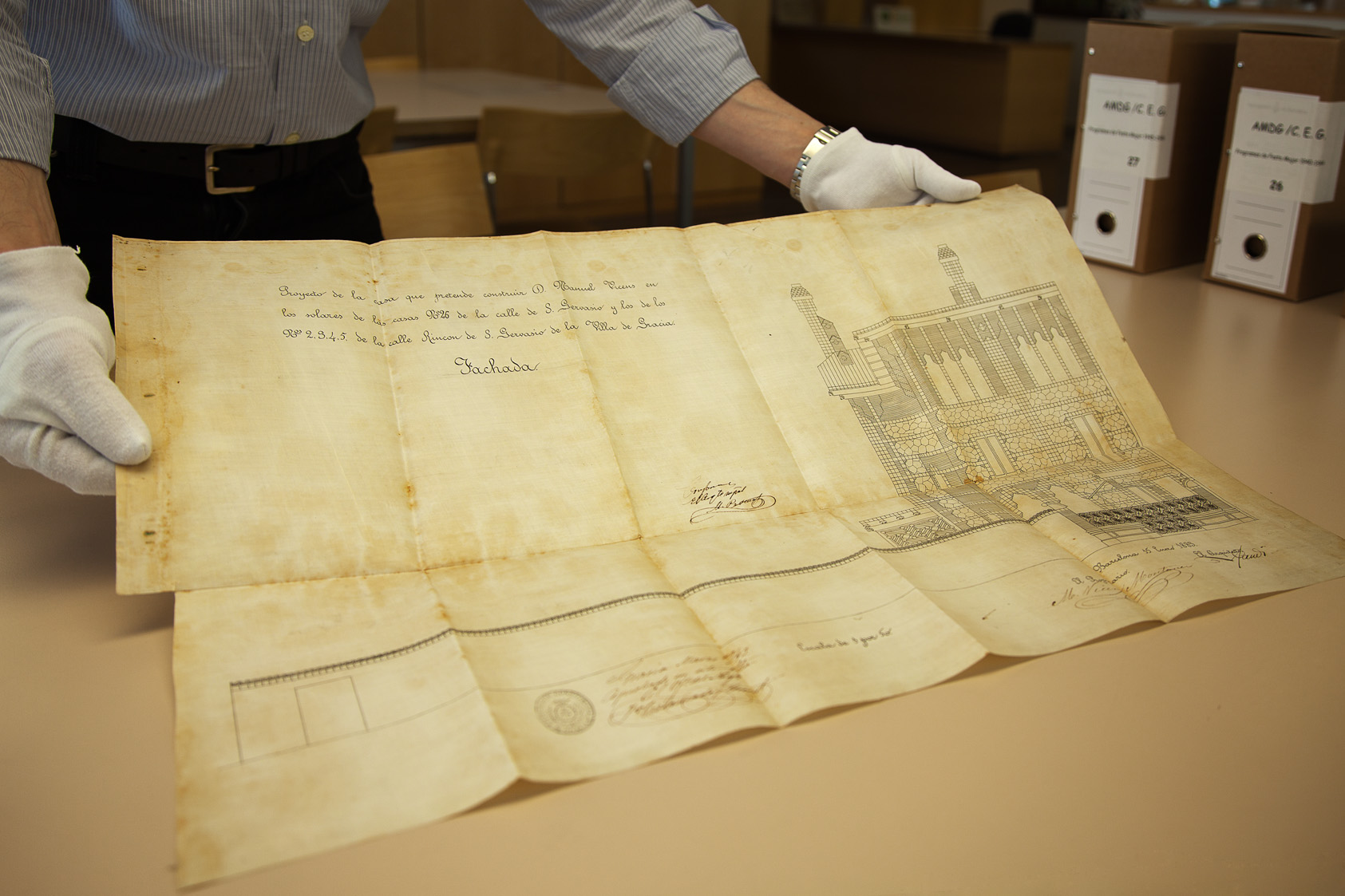
White gloved hands holding a plan of Gaudí’s Casa Vicens spread out on a table.

The AMDG conserves records from the old municipality of Gràcia, such as this plan of the Casa Vicens project, by Gaudí, from 1883. Carme García Navarro

Slide 1 of 1

Documents

  • Quadre de fons AMDG (PDF 188.65 KB)
Barcelona City Council logo
  • Accessibility
  • Legal notice
  • Contact us