

Palau del Marquès d’Alfarràs at Parc del Laberint d’Horta
Guided tours
The Palau del Marquès d’Alfarràs is opening its doors to city residents. Visit this historic site, free of charge, and discover over a thousand years of history in the heart of the Parc del Laberint d’Horta.
Following its restoration, the Municipal Institute of Parks and Gardens is offering free guided tours of the Palau del Marquès d’Alfarràs, located in the Parc del Laberint d’Horta.
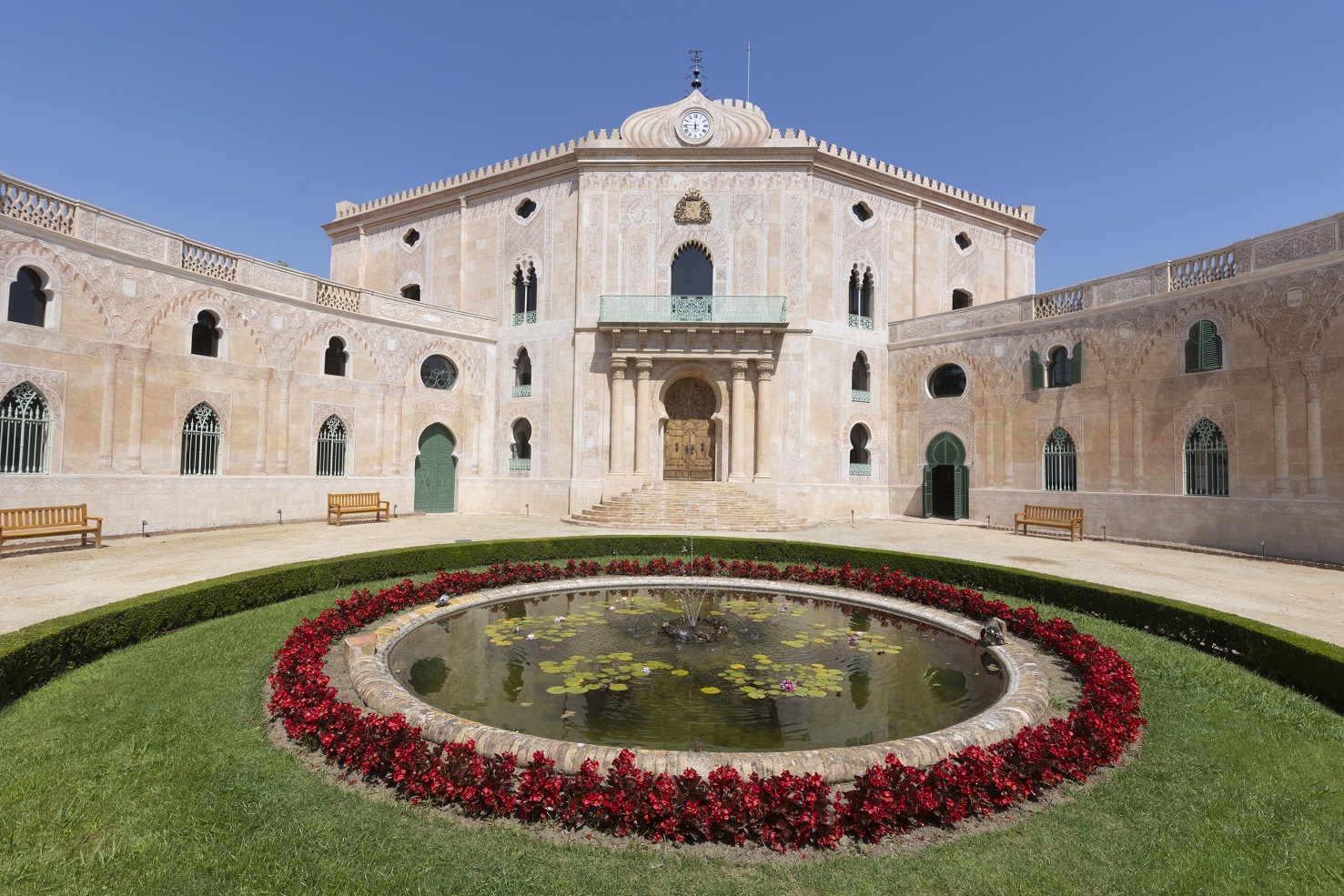
The Palau del Marquès d’Alfarràs, also known as the Palau Desvalls, is a heritage site with over a thousand years of history, dating back to the 11th century when it was originally a watchtower.
In 1968, ownership of the building and gardens was transferred to the City Council. Since 1993, part of the palace has been used by the Laberint Training Centre to run courses and workshops on gardening, agriculture and biodiversity. Now, for the first time in its history, it is open to the general public.
Parks and Gardens invite you to sign up for guided tours to explore this remarkable palace and discover a restored corner of the city's heritage.


Ticket reservations will open one week before the date of the visit (on Wednesdays at 12 pm).
History
The Palau d’Alfarràs is a manor house with a long history that dates back to the construction of the defensive tower in the 11th century. A century later various buildings were added to it and it became an agricultural estate until, at the end of the 14th century, the property was acquired by Jaume de Vallseca, a member of one of the most powerful lineages in Barcelona.
In the 18th century, the Llupià family, descendants of the Vallsecas and inheritors of the estate, acquired neighbouring estates and redeveloped the main building. In 1789, Joan Antoni Desvalls (1740-1820), Marquis of Alfarràs and Llupià, inherited his mother's property and extended the estate again. Whilst various improvement works were being carried out there, work began on the construction of the garden.
Following the Peninsular War, his heirs still wished to improve the estate and one of the first actions they undertook was the construction of the Els Boixos garden, based on a project designed by Swiss architect Domenico Bagutti (1760-1837), who worked for the Desvalls family from 1799.
Between 1845 and 1847 the general reform of the house façade was carried out, along with the construction of the side wings which define the circular courtyard at the entrance. It was during this period that the façades were decorated with frescoed stuccoes by the painter Lluís Rigalt (1814–1894), using a range of shapes inspired by neo-Arab and neo-Gothic styles. Around 1860, a new building with a rectangular floor plan was added, in which the so-called ‘Noble Rooms’ were located on the first floor.
The Desvalls family held the property until 1967, the year in which the estate was handed over to Barcelona City Council, who opened it as a public park in 1972. Since 1993, part of the house has been used by the Laberint d’Horta Training Centre, which offers courses and workshops in gardening, agriculture and biodiversity. The latest improvement works have been carried out this year with the aim of restoring some of the house’s singular elements and opening the space to the public.
Ladies at the entrance to the Marquess of Alfarràs Palace in the Horta Labyrinth Park gardens, at the beginning of the 20th century. Collection: Felip Capdevila i Rovira. Photographer: Unknown. 1900–1920. Horta-Guinardó District Municipal Archives
Bedroom at Marquess of Alfarràs Palace. Photographer: Unknown. 1930-1935. Barcelona Photographic Archive.
A couple seated in the Horta Labyrinth Park gardens. Collection: Felip Capdevila i Rovira. Photographer: Genovart. 1930. Horta-Guinardó District Municipal Archives


