
Using sensors to improve playgrounds
How do they work?
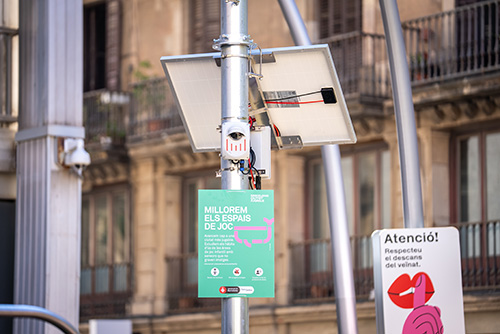
Volumetric sensors are being installed in various playgrounds in the city, on a monthly rotating basis, to gather information about these spaces and how they are used and improve their design.
Rather than capturing images or sounds, these sensors collect metadata to learn about activity at playgrounds by establishing users’ approximate ages based on their height, logging the time of day and length of visits and identifying how the facilities are used.
Sensors will be placed in the following ten play areas:
• Plaça de Sant Miquel (Ciutat Vella)
• Jardins de la Indústria (Eixample)
• Jardins de la Mediterrània (Sants-Montjuïc)
• Plaça de Margarita Rivière Martí (Les Corts)
• Jardins d’Elvira Farreras Valentí (Sarrià-Sant Gervasi)
• Jardins de Maria Baldó (Gràcia)
• Plaça de les Pedreres de Can Baró (Horta-Guinardó)
• Plaça del Virrei Amat (Nou Barris)
• Parc d’Antoni Santiburcio (Sant Andreu)
• Poblenou Superblock (Sant Martí)
The installation was preceded by a comprehensive analysis – a pioneering initiative in southern Europe – that involved placing thermal buttons on the play equipment to monitor temperatures, giving children special wristbands to wear and surveying nearly 10,000 users to supplement the fieldwork.
The initial assessment shows that playgrounds are a central and unifying part of neighbourhood life: children spend over 30 minutes a day in these spaces, which strengthen community life. The average age of the children who use them is around five years old.
What do city children’s favourite areas have in common?
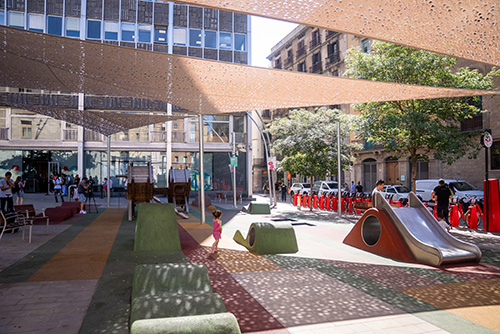
Children’s favourite areas are spacious and feature a range of play equipment suitable for various age groups.
Children’s favourite features are multi-play structures, swings and slides.
As for the equipment they wish they had, trampolines and zip lines are at the top of their list. They are highly popular in the playgrounds that do have them.
Children and families alike appreciate quiet playgrounds with greenery that are far from traffic.